
A guide to Czech customs and etiquette — the unspoken rules that separate a tourist from a local in Prague.
The Culture Shock Nobody Warns You About
Understanding Czech customs and etiquette starts with one trait: Czechs value directness over small talk. That one thing confuses new expats more than the language barrier. A blunt “no” from a shopkeeper or coworker isn’t rudeness — it’s efficiency. Reading it as coldness instead of a different social default is the single biggest culture-shock trap for teachers moving to Prague.
If you’re an expat moving to Prague, these tips will help you get acquainted with your new city. If you’re an expat teacher still deciding whether to move to teach in Prague or elsewhere in Europe, the Teach in Europe Guide gives you everything you need to decide. This post is the etiquette you’ll live by if you choose to live in or visit Prague.

Prague Castle watching over the Vltava — this is the view you stop noticing once it’s just your commute.
How Do You Greet People in Czech Culture?
You greet with “dobrý den” (good day) in any formal or first-time interaction — shops, restaurants, your school, a new neighbor — and reserve the casual “ahoj” for people your age or younger who greet you that way first. Using “ahoj” too early reads as overly familiar.
Czech also has a formal/informal grammar split — vykání (formal “you,” vy) versus tykání (informal “you,” ty) — that mirrors the greeting rule. Teachers should default to vy with adults, colleagues, and anyone older, and let the other person invite the switch to ty. Czech workplace address customs confirm that the higher-status or older person initiates this switch, not the newcomer. Getting it wrong isn’t offensive, but it does mark you as new.
Eye contact matters most during a toast. Czechs consider skipping eye contact while clinking glasses bad luck, and, more practically, it reads as insincere — they notice it even when they don’t say anything.
What Pub and Dining Etiquette Should You Know?
You order at the counter or wait to be seated — never both — and a proper Czech pub, or hospoda, runs on its own quiet rules. Servers rarely hover; you settle the tab at the end, and you ask for the check verbally, not by waving.
Tipping is lighter than in the U.S.: rounding up or adding around 10% is standard, not the 18–20% Americans are used to. Local tipping norms in Prague note that tipping isn’t customary at all for public services, museums, or ticket counters — only in restaurants, cafés, and taxis. Overtipping doesn’t read as generous so much as it reads as not knowing the norm.
Czechs order beer by size and brewery, not just “a beer” — malé (0.3L) or velké (0.5L). Regulars stay loyal to a specific brand (Pilsner Urquell, Staropramen, Kozel) the way Americans stick to a coffee chain. Ordering by size and name, without over-explaining, is one of the fastest ways to tell you actually live there.
What Should You Know Before Visiting a Czech Home?
Take your shoes off at the door — always. This holds even at casual gatherings, and most homes keep a basket of guest slippers by the entrance for exactly this reason. Walking in with shoes on is one of the fastest ways to signal you’re new.
Never arrive empty-handed. A bottle of wine, a small bouquet, or chocolate is expected, even for a casual dinner. Czech gift-giving etiquette specifies that flowers should be given in odd numbers, unwrapped before handing them over, and never chrysanthemums, which are reserved for graves. Wrapped, even-numbered bouquets read as funeral flowers.
Punctuality is taken seriously. Arriving more than 10–15 minutes late without a heads-up reads as a real lapse, not a casual “running behind.” If you’re running late, send a short text — don’t skip it. Rules like this show why Czech customs and etiquette lean toward precision over the more relaxed American default.
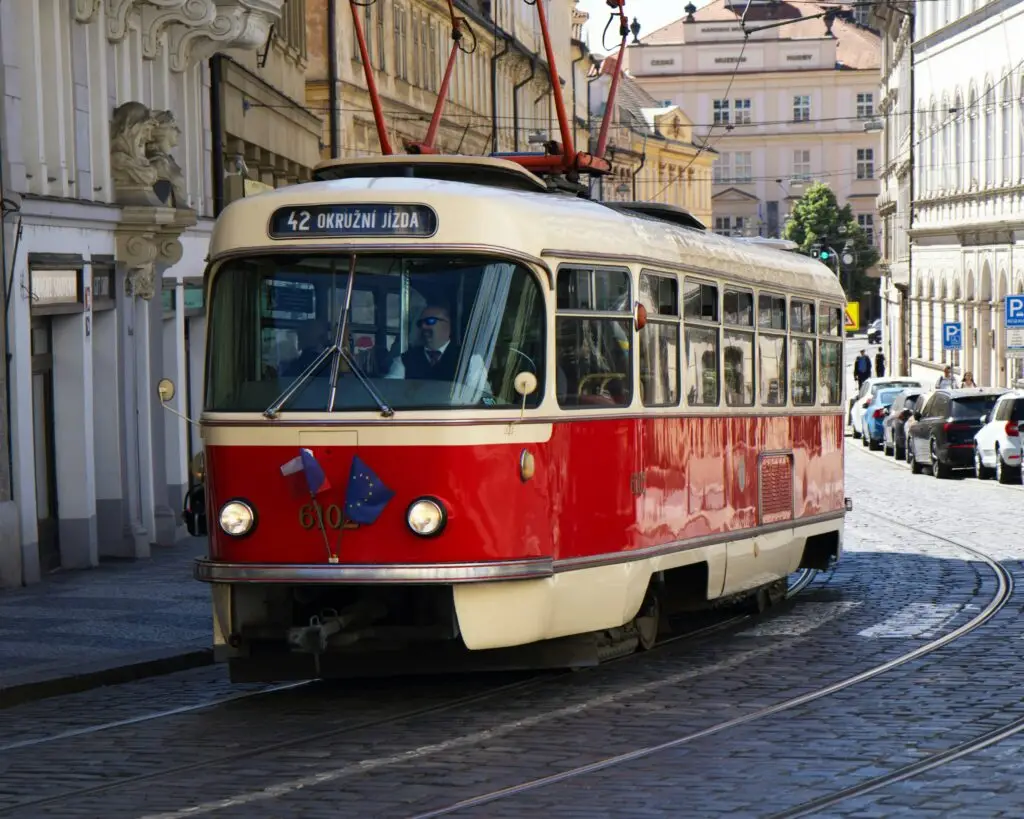
The trams run on a schedule locals mentally track — no signage required, just habit.
What Are the Unspoken Rules in Public Spaces?
Stand right, walk left on escalators — this single habit marks you as a local or a tourist faster than almost anything else in Prague. Blocking the left side, even briefly, draws visible irritation from commuters in a hurry.
Czechs form orderly, unspoken queues in shops and at counters. There’s rarely a visible line, but everyone tracks who arrived when, and locals notice cutting in immediately, even by accident. When in doubt, ask “kdo je poslední?” (“who’s last?”) before assuming your place.
Public transit is quiet. Loud phone calls, music without headphones, and boisterous conversation on trams or the metro draw stares. Czechs default to reading, scrolling, or sitting in silence, and matching that energy is part of blending in.
Don’t smile at strangers by default. In Czech culture, an unprompted smile at someone you don’t know reads as insincere rather than friendly — the opposite of the American default. Save it for people you actually know.
FAQs: Czech Customs and Etiquette
Q: Is it rude to speak English in Prague? A: No — most Praguers under 40 speak strong English. But opening with a Czech greeting like “dobrý den” before switching to English reads as respect, not competence, and goes a long way in shops and restaurants.
Q: Do Czechs expect small talk with strangers? A: Not really. Directness is the cultural default, and skipping small talk with a cashier or service worker isn’t coldness — it’s simply efficient, and expected on both sides.
Q: What’s the biggest etiquette mistake new expats make in Prague? A: Keeping shoes on indoors and over-smiling at strangers are the two most common — both read as small mistakes to Czechs, but both instantly signal you’re new.
Q: How formal is Czech workplace culture? A: More formal than casual U.S. workplaces at first contact — using vy (formal “you”) with colleagues and supervisors until invited to switch is the safe default, especially in a school setting.
Just Let It Become Normal
These aren’t rules to memorize and recite — they’re signals that you plan to actually live somewhere, not just pass through it. Get the shoes, the greeting, and the escalator habit down, and the rest of the Czech customs and etiquette follow naturally.
For the logistics behind the move itself — visa, salary, job market — read the complete guide to teaching English in Prague. For what daily life looks like once you’re settled, see teaching abroad daily life.