
A Czech beer guide covering everything you need to know — beer types, pour styles, pub etiquette, and where the pilsner style began.
Czech Beer Is a Whole Culture, Not Just a Drink
A Czech beer guide sounds like overkill for a drink, until you sit down at a real Prague hospoda and realize everyone around you knows words you’ve never heard. The Czech Republic drinks more beer per person than anywhere else in the world. The culture around it runs on a few specific, mostly unspoken rules — the type, the pour, the coaster, the tab. Once you know them, it’s easy.
This applies whether you’re in Prague for a weekend or planning to stay much longer. If you’re planning a longer stay, the Teach in Europe Guide covers that bigger decision — but this post is about not looking lost at the bar, whether you’re passing through or putting down roots.
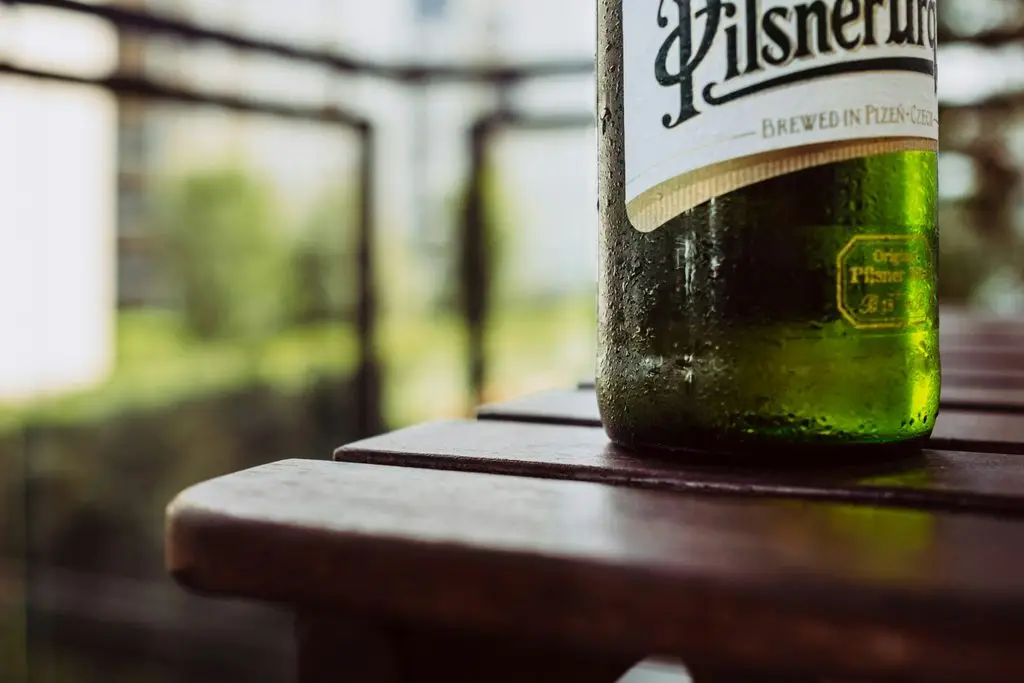
What Are the Basic Types of Czech Beer?
Forget IPA, stout, and wheat beer categories. The Czech system is built around color and strength instead. Světlé pivo (light beer) is the classic golden Czech lager. It’s what roughly 80% of Czechs drink by default. Say nothing else, and this is what arrives.
Tmavé pivo (dark beer) is a dark lager with caramel and roasted malt flavors. It’s lighter-bodied and sweeter than a British stout — a good one to try early in your visit. Řezané pivo (cut beer) blends light and dark drawn from both taps into the same glass, layered by the bartender. Not every pub offers it, but it’s worth ordering once you find it. Polotmavé pivo (semi-dark) sits between the two, with some caramel character but the drinkability of a světlé.
What Do the Degree Numbers Actually Mean?
You’ll see beers labeled 10°, 11°, or 12° on the menu or the tap. This has nothing to do with alcohol content, even though it looks like it should. The number tells you how strong and full the beer will taste. It’s an old brewing measurement, not a modern one. A desítka (10°) is lighter and easier to drink. A dvanáctka (12°) is fuller and closer to the classic Pilsner taste.
Saying “dvanáctku, prosím” (a twelve, please) at a pub with multiple taps tells the bartender exactly what you want. No further explanation needed. This is the kind of detail most Czech beer guide posts skip. But it’s the one that actually gets you the beer you meant to order.
What Is Tank Beer, and Why Does It Matter?
Tankové pivo (tank beer) is unpasteurized lager sent straight from the brewery to big cold tanks in the pub’s basement. It skips bottling and the extra air exposure that makes regular keg beer taste less fresh. The result tastes noticeably better — the same Pilsner Urquell tastes different from a tank than from a bottle.
Look for a “tankové pivo” sign outside a pub. The price is usually the same as regular draft, roughly 55–80 CZK for a half-liter. There’s no real reason to skip it when it’s available.
How Do You Actually Order at a Czech Pub?
Czech beer isn’t ordered by size alone. It’s ordered by pour style, and this is a real Czech custom, not something made up for tourists. Hladinka is the standard pour: two-thirds beer, one-third thick foam. Just say “pivo, prosím,” and this is what you’ll get. Šnyt is a smaller pour with a bigger head of foam. Locals often order it late at night, when they want one more but not a full glass. Mlíko is mostly foam with very little beer — a Prague specialty, not a mix-up.
A few phrases go a long way: “velké pivo” for a large (0.5 liter, the default), “malé pivo” for a small (0.3 liter), and “na zdraví” for cheers. Any Czech beer guide worth reading will tell you this one rule: don’t clink glasses when toasting with beer. In Czech culture, it’s considered bad luck, unlike the custom with wine. Look the other person in the eye instead when you say it.
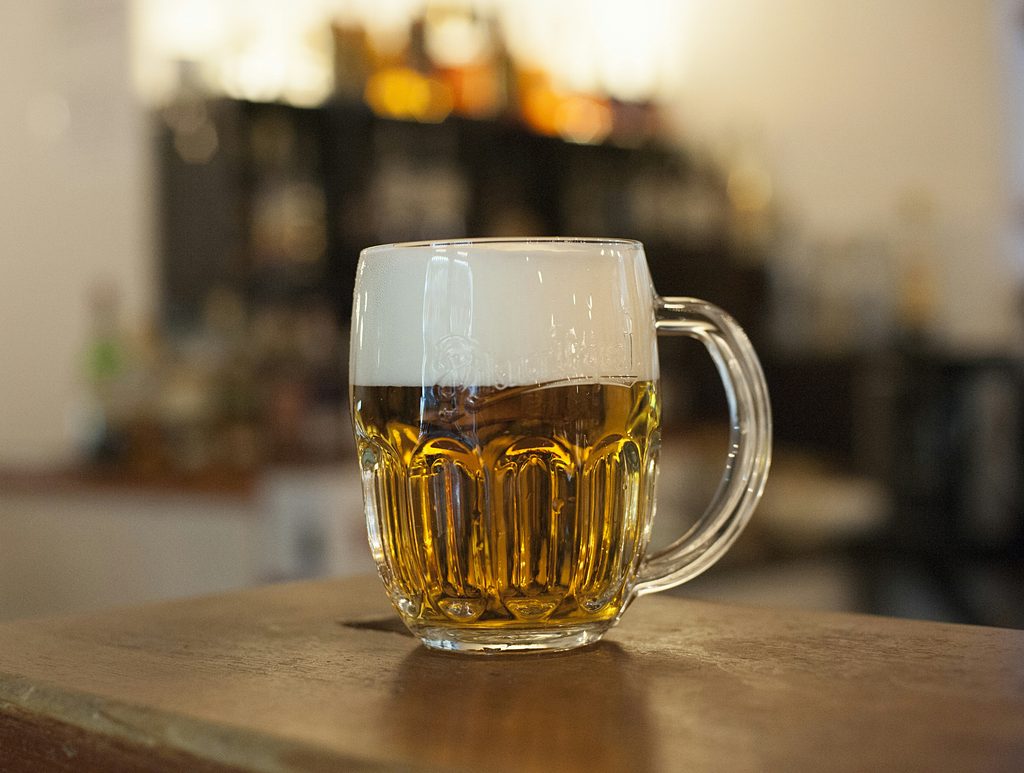
This is what a hladinka pour actually looks like — get used to seeing this much foam.
What Are the Unspoken Pub Rules?
Traditional pubs often run on an auto-refill system. The moment your glass is empty, a fresh beer appears, and the bartender marks it on a paper tab at your table. This isn’t a trick to upsell you. It’s one of the first things any Czech beer guide should warn you about before your first round. Want to stop? Place your coaster on top of your empty glass. That’s the universal signal that you’re done.
Complaining that a beer has too much foam is a real mistake in a Czech pub. The foam keeps the beer fresh, and locals take it seriously. Also, unlike American bars, Czechs usually pay for their own drinks instead of buying rounds. Don’t feel like you have to cover the whole table.
How Much Should You Tip?
Ignore any Czech beer guide that tells you to tip 15–20%. That’s an American norm, not a Czech one, and locals don’t do it. The actual standard is far more modest: round up to the nearest 10 or 20 CZK, or add about 10% for table service. Leaving exact change at the bar is completely normal. Nobody sees it as stingy.
What Should You Eat With Your Beer?
Svíčková — beef sirloin in cream sauce with bread dumplings and cranberry sauce — is the national dish. It’s worth ordering at least once, even though it’s not strictly pub food. Smažený sýr (fried cheese, usually breaded Edam) is simpler and filling — exactly what you want after a couple of beers.
Nakládaný hermelín (marinated cheese) is another pub staple: a soft, Camembert-style cheese marinated in oil with garlic, onion, and spices, usually served with rye bread and a few pickles on the side. It pairs well with a cold pilsner and takes days to prepare, so a pub that has it on the menu is usually a good sign. Honestly, smažený sýr and nakládaný hermelín are still two of my all-time favorites. I think about them more often than I’d like to admit, and just writing this section made my stomach growl. Many traditional pubs keep the food menu short on purpose. A limited menu often signals that the beer is the real point.
Should You Visit Pilsen, Where It All Started?
No Czech beer guide is complete without a trip to the source. If you want to go straight there, Pilsen (Plzeň) is where pilsner-style beer was invented, and it’s an easy day trip from Prague — about 90km away, roughly 1 hour 20 minutes by direct train. In 1842, a Bavarian brewer named Josef Groll was hired by local citizens who were tired of their bad beer. He combined Bohemian hops, Moravian barley, and the city’s unusually soft water with a bottom-fermenting technique from Bavaria, and the result was the world’s first clear, golden lager. Nearly every pilsner-style beer made today, in the Czech Republic or anywhere else, traces back to that one batch.
The original brewery still operates on the same site, and tours run through the modern brewing facility, the historic underground cellars (kept at a constant 2°C), and end with a taste of unfiltered beer straight from the barrel — something you genuinely can’t get anywhere else, including in Prague. If you want the full trip planned out, day trips from Prague cover Pilsen alongside a few other options worth the train ride.
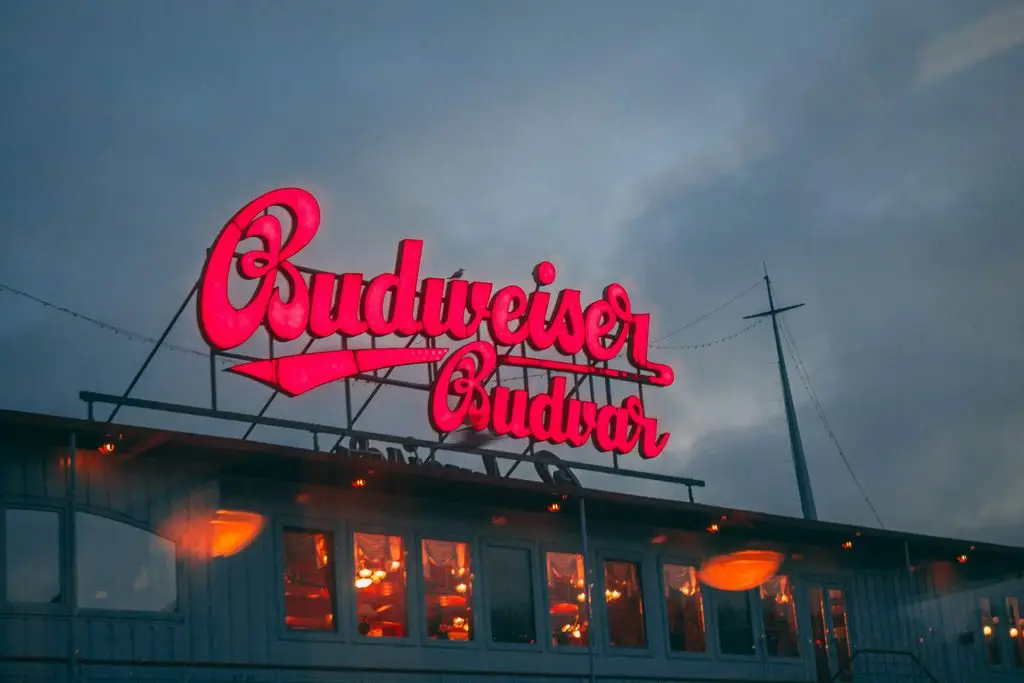
Not that Budweiser — this is the original, still brewed in České Budějovice.
What About České Budějovice, Home of Budvar?
If Pilsen is the birthplace of the pilsner style, České Budějovice is where Budweiser Budvar comes from — the beer at the center of that century-old trademark fight mentioned earlier. Budvar is technically a pilsner too, just its own take on it: founded decades later in 1895, with milder bitterness and a slightly higher alcohol content than Pilsner Urquell. It’s about 150km south of Prague, roughly a 2-hour direct train ride from Praha hlavní nádraží.
The brewery sits about 2–2.5km north of the city center, an easy trolleybus ride or a 20–30 minute walk from the train station. Public tours typically run in the afternoon, and if you want one in English, it’s worth booking ahead — tours in Czech run more often. The tasting at the end pours beer straight from the lagering tanks, which is about as fresh as it gets. Beyond the brewery, České Budějovice is a genuinely nice small city in its own right, with a large main square worth wandering before you head back to Prague.
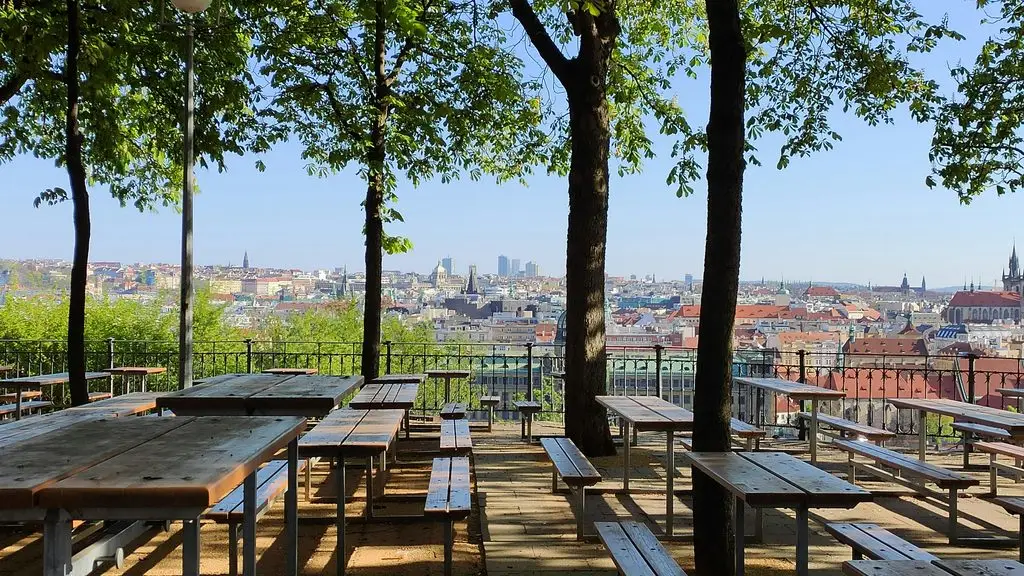
Letná on a quiet morning — come back at sunset, and every one of these tables will be full.
What About Beer Gardens?
Pubs aren’t the only scene. Prague’s beer gardens host a lot of the real social life, especially once the weather turns.
Letná and Riegrovy sady
Letná Park and Riegrovy sady are the two most well-known beer gardens. Both sit on hills with views over the city. Both become the default meeting spot as soon as it’s warm enough to sit outside.
I spent a lot of time at both during my time in Prague. Riegrovy sady in particular became the go-to for watching football matches. A big screen, cheap beer, and a crowd that grows as the game goes on. Beer gardens also make it easy to gather a big group without much planning. On days like St. Patrick’s Day, we’d end up with 25 people sprawled across a few picnic tables, no reservation needed. And yes, we joked more than once that the beer was cheaper than the water. A half-liter at a beer garden often costs less than a bottled water from the same kiosk. That never stopped being funny.
The Strahov Monastery Brewery
Letná and Riegrovy sady are the two most famous, but they’re far from the only options. My very first stop was actually the Strahov Monastery Brewery (Klášterní pivovar Strahov). I visited on a hop-on-hop-off bus tour on my first full day in Prague, before I knew much about beer styles or ABV.
It sits right next to Prague Castle, inside a monastery complex founded in 1142. Monks have brewed beer on the site for more than 600 years. The current brewery has operated continuously since 2000. Their own beer, St. Norbert, comes in amber, dark, and seasonal varieties (a wheat special shows up around the winter holidays). The courtyard beer garden opens in the warmer months. The restaurant inside handles the rest of the year. It’s open daily from 10 am to 10 pm, and it’s still one of my favorite places in the city to have a first Czech beer.
More Beer Gardens Worth Knowing
Parukářka, up on the Žižkov hill, is a locals-only spot with cheap lager in glass mugs and a free panoramic view of the TV Tower and the Castle. Náplavka, the embankment along the Vltava, turns into an outdoor party most summer evenings. Converted cobble vaults serve beer right along the river. For something quieter, Na Hradbách sits inside the Vyšehrad fortress walls — beer, a grill, and old stone walls instead of a crowd. And if you’ve read the neighborhood comparison post, you already know Havlíčkovy sady (Grébovka) in Vinohrady. The same park with the Neptune grotto also runs a small vineyard and its own beer garden in season.
FAQs: Czech Beer in Prague
Q: What beer should a first-timer order in Prague? A: A světlé (light lager) at 12° — this is the classic Czech style most people picture, and pretty much every pub serves a solid version of it.
Q: Is it rude to order a small beer as a man? A: Not rude exactly, but it’s genuinely unusual — ordering a large (0.5 liter) by default is the norm regardless of gender, and a small beer sometimes gets a raised eyebrow.
Q: How do I know if a pub serves tank beer? A: Look for a “tankové pivo” or “pivo z tanku” sign outside or near the entrance. If you don’t see one, just ask — “Máte tankové pivo?”
Q: Do I need to speak Czech to order? A: No — most pubs, especially in the city center, have staff who speak English. Learning a few phrases like “pivo, prosím” earns you a smile, but it’s not required to get a beer.
The Details Are the Whole Point
If this Czech beer guide has one takeaway, it’s that the details are the whole point. It’s really just a handful of small habits. They’re what separate someone who’s spent real time in a Czech pub from someone who hasn’t. Order by color and strength, know your pour style, respect the coaster, and tip a little. That’s really all there is to it.
Whether you’re here for a few days or considering a longer stay, the Teach in Europe Guide is there if you’re weighing the bigger decision. For more on daily life in the city, see Czech Customs and Etiquette Every Expat Should Know and Where to Live in Prague for more on the Vinohrady park mentioned above.
If you have ever thought about moving to teach in Prague, grab the free pre-departure checklist below.