
Planning spring break in Rome? This complete guide covers how many days to stay, what to eat, and the best sights, with real tips from my own trip.
Rome was the right kind of overwhelming. On my last trip, I stuck to the classics and still found time for a long lunch every single day. This is everything I’d tell you before your own spring break in Rome.
Looking at a few options before you commit? My 5 Week-Long Spring Break Destinations in Europe covers Rome alongside Vienna, Prague, Split, and Athens, if you want the bigger picture first.
Four days is the sweet spot for a first trip to Rome. That’s enough time for the Colosseum, the Vatican, a few piazzas, and more pasta than you’d admit to. Rome rewards a slower pace, so resist the urge to pack every hour.
You’ll get a full breakdown of where to stay, what to eat, how to get around, and how to fit it into a week-long break. You’ll also get my favorite restaurant discovery: a tiny street near Piazza Navona I’d go back for in a heartbeat.
Need help fitting this into your actual school calendar? Teacher Break Trip Planner builds trips around real break windows.
The Pantheon, seen from above over Piazza della Rotonda.
How Many Days Do You Need in Rome?
Four days cover Rome’s major sights without rushing, and five lets you slow down and wander. Rome is dense with history, so even a short list of “must-sees” adds up fast.
Here’s a simple four-day plan:
- Day 1: Colosseum, Roman Forum, Palatine Hill
- Day 2: Vatican Museums, Sistine Chapel, St. Peter’s Basilica
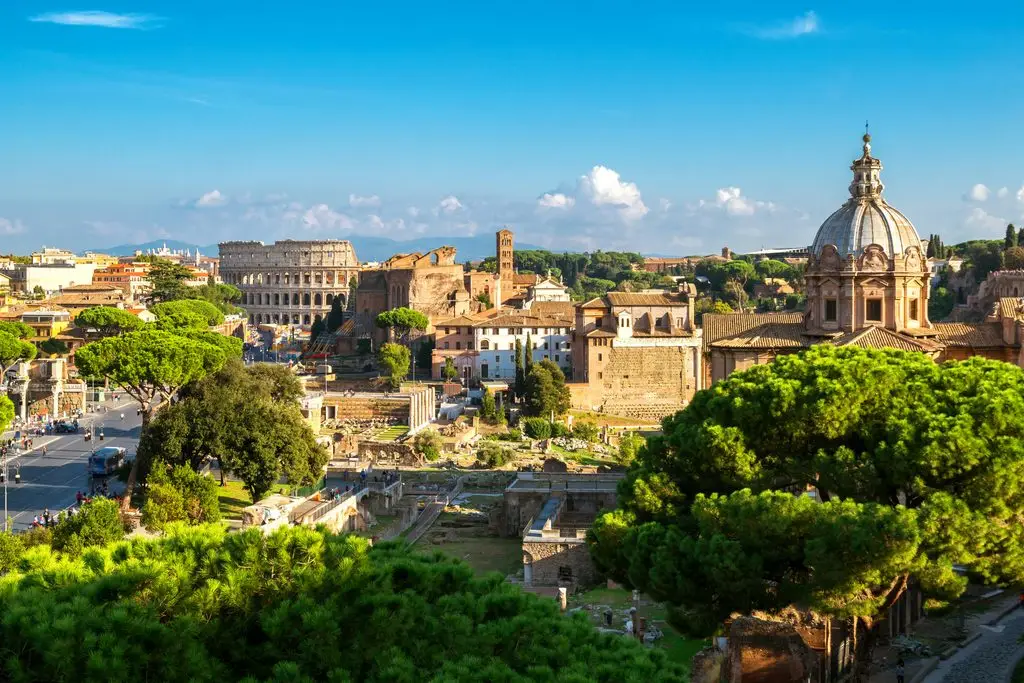
- Day 3: Pantheon, Piazza Navona, Trevi Fountain, Spanish Steps
- Day 4: A slow morning in Trastevere, your home base, before one more long lunch
On my trip, I stuck to the main sights and still found time for a long lunch every day. That pace felt right. Rome punishes a rushed itinerary more than most cities.
Where Should You Stay?
Stay in Trastevere if you want an easy walk to most of Rome’s major sights, with a lively, local feel at night. Rome’s public transit is useful but not as fast or seamless as Vienna’s or Prague’s, so location matters more here.
I stayed at Villa della Fonte in Trastevere, and it was perfect for getting around. The neighborhood put me within walking distance of the center, and I still got the cobblestone streets and ivy-covered buildings Trastevere is known for.
If you’d rather stay closer to the Pantheon and Piazza Navona, Centro Storico is the most central option. Monti is a quieter alternative near the Colosseum.
Looking for a place to stay? See hotels and vacation rentals in Rome.
Getting Around Without a Car
Walk whenever you can — Rome’s historic center is dense and most major sights sit within a 20-30 minute walk of each other. The city’s layout rewards wandering, and walking is often faster than waiting for transit in the center.
For longer distances, the metro has only two main lines (A and B), so it doesn’t reach every corner of the city the way Vienna’s or Prague’s systems do. Buses fill the gaps but can be slow and crowded.
A few practical notes:
- Cobblestones are everywhere. Comfortable, broken-in shoes matter more in Rome than in most European capitals.
- Taxis are easiest from official stands, not hailed on the street. Ride-share apps work but can be inconsistent.
- A single transit ticket covers 100 minutes across bus, tram, and metro, which is handy if you’re hopping between a couple of sights farther apart.
What to Pack for Rome in Spring
Pack layers, comfortable walking shoes, and something that covers your shoulders and knees for the Vatican. Spring weather in Rome swings between cool mornings and warm afternoons, so layers matter more than any single heavy coat.
The Vatican Museums, St. Peter’s Basilica, and the Pantheon all enforce a modest dress code: shoulders and knees covered, no low-cut or sleeveless tops. A light scarf is an easy fix if you’re wearing something sleeveless elsewhere that day.
Other packing notes:
- Shoes: Something broken-in. Cobblestones are unforgiving on new shoes.
- A small daypack: Most major sights allow small bags, but security lines move faster when you have less to check.
- A portable charger: You’ll use your phone constantly for maps, tickets, and photos.
- A refillable water bottle: Rome has public drinking fountains (nasoni) all over the city, so you rarely need to buy bottled water.
What Does Rome Cost, Roughly?
Rome can work on a modest budget or a more comfortable one, depending mostly on how you handle food and museum tickets. Here’s a rough sense of where the money goes.
| Expense | Budget-conscious | More comfortable |
|---|---|---|
| Hotel/rental (per night) | $80-120 | $150-250+ |
| Meals (per day) | $30-45 | $60-100 |
| Major sight tickets (Colosseum, Vatican) | $20-30 each, book ahead | Same, plus a guided tour add-on |
| Local transport | $1.50 per ride, or a day pass | Occasional taxis |
Skip-the-line tickets cost more than general admission but save hours during spring’s busy season, which usually makes them worth it.
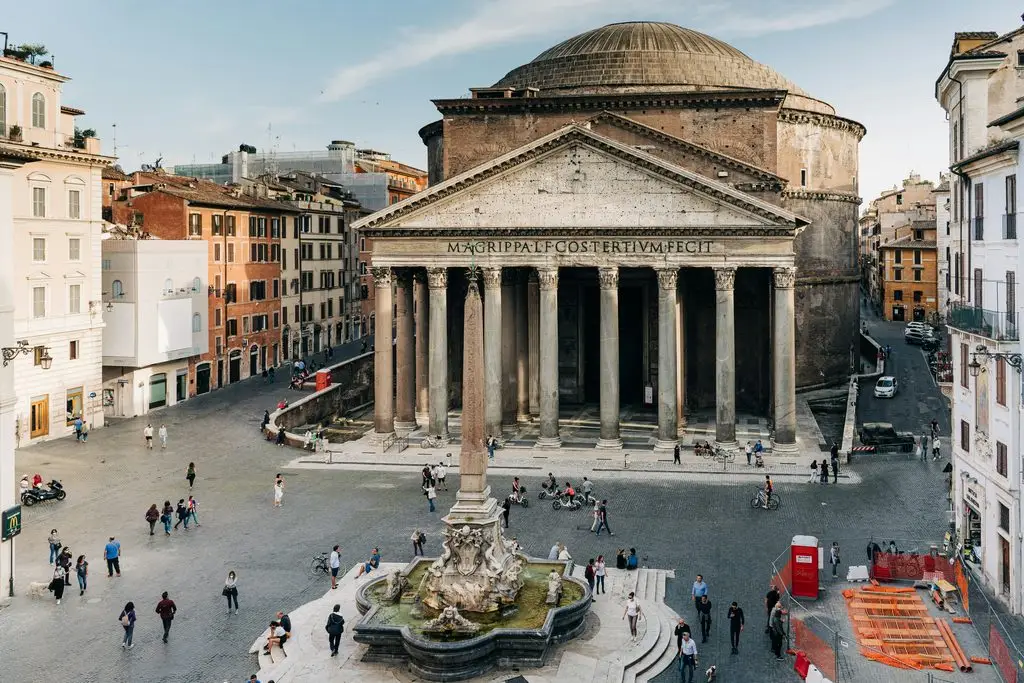
The Pantheon, seen from above over Piazza della Rotonda.
What Are the Best Things to Do in Rome?
The Colosseum, the Vatican, and the Pantheon are Rome’s non-negotiables, but the smaller piazzas are where the city wins you over. Book the Colosseum and Vatican Museums online in advance. Spring is a busy season, and lines without a ticket can eat a whole morning.
A few favorites beyond the big three:
- Pantheon: a nearly 2,000-year-old Roman temple with the world’s largest unreinforced concrete dome, free to enter
- Piazza Navona: a lively square built over an ancient stadium, with street artists and fountains
- Trevi Fountain: small, crowded, and worth it anyway — toss a coin in
- Spanish Steps: a people-watching spot at the base of a church
- Trastevere: cobblestone streets, ivy-covered buildings, and some of the best food in the city
- Via dei Coronari: a quiet, antique-lined street near Piazza Navona, and the location of my favorite meal in Rome (more on that below)
Best time of day to visit crowded spots
Visit the Trevi Fountain and Pantheon early morning or after dark to avoid the worst crowds. Both sit right in the flow of daytime foot traffic, and a 7 or 8 a.m. visit (or a stop after dinner) feels like a completely different experience.
The Colosseum and Vatican Museums are the opposite: book the earliest entry slot you can get, since both get more crowded as the day goes on, not less.
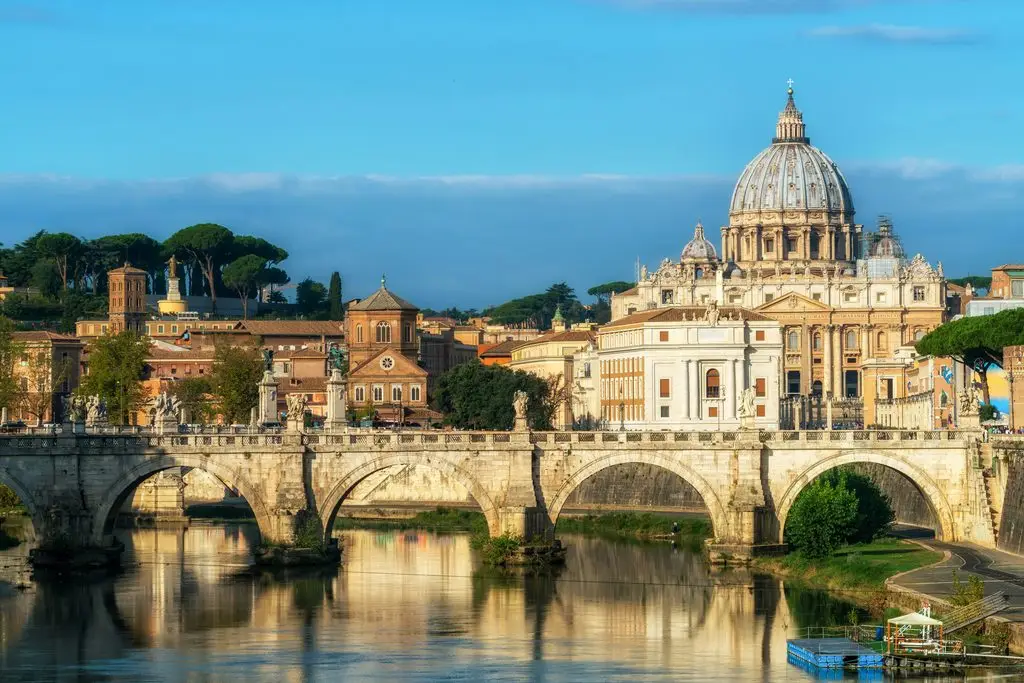
St. Peter’s Basilica and the Tiber, seen from Ponte Sant’Angelo.
Is Vatican City Its Own Stop?
Yes — Vatican City is technically its own country, the smallest in the world, and worth treating as a distinct stop rather than just another Rome neighborhood. Geographically, it sits inside Rome, but it has its own government, postal service, and border.
St. Peter’s Square and St. Peter’s Basilica are free to enter, no ticket required, which makes them easy to pair with a paid visit to the Vatican Museums and Sistine Chapel next door. Expect a security checkpoint at the Basilica entrance, with the same dress code enforced there as in the Museums.
A few things worth knowing before you go:
- The Swiss Guard still protects Vatican City today, recognizable by their striped Renaissance-era uniforms.
- Climbing the dome of St. Peter’s Basilica costs extra and involves a lot of stairs, but the view over Rome is worth it if you have the time and the legs.
- Vatican City issues its own stamps, and a small post office near the square sells them if you want a unique souvenir or postcard.
Teacher tip: Pair St. Peter’s Square and Basilica with your Vatican Museums day, since they’re a short walk apart. Doing them on separate days wastes time you don’t need to lose.
Common Rome Tourist Mistakes to Avoid
The biggest mistakes in Rome are skipping advance tickets, falling for street scams near major sights, and overpaying at restaurants with photo menus out front. None of these are hard to avoid once you know what to look for.
- Not booking the Vatican and Colosseum ahead of time. Walk-up lines in spring can run over an hour.
- “Free” bracelet or rose sellers near major landmarks. A polite but firm “no, grazie” works better than engaging at all.
- Restaurants with laminated, photo-heavy menus right outside major sights. These usually mean inflated prices and lower quality. Walk a few streets away from the main attraction instead.
- Taxis that don’t use the meter. Confirm it’s running, or agree on a fixed price before you get in.
- Wearing shorts or a sleeveless top to the Vatican without a backup layer. You’ll be turned away at the door, no exceptions.
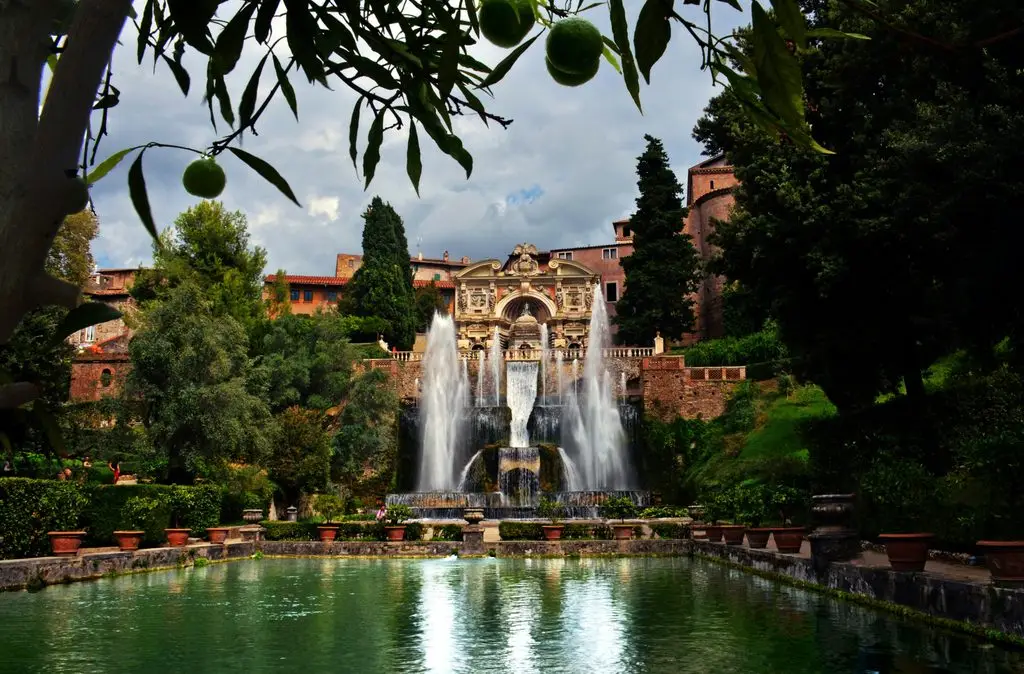
The Fountain of Neptune at Villa d’Este in Tivoli, an easy day trip from Rome.
Day Trips Worth Taking From the City
Tivoli, Florence, and Pompeii are the three easiest day trips from Rome, and you can reach each by train without a car. If your break runs closer to 10 days, adding one is a good way to see more of Italy without giving up your base in Rome.
- Tivoli: About 45-55 minutes each way by regional train. Home to the Villa d’Este’s fountains and gardens and the ancient ruins of Hadrian’s Villa. The easiest and shortest of the three, and good for a half-day.
- Florence: About 1.5 hours each way on a high-speed train. Worth a full day for the Duomo, the Uffizi Gallery, and the Ponte Vecchio. Book tickets a few weeks ahead, since fares climb closer to the date.
- Pompeii: About 2 hours each way, usually with one train change in Naples. The ancient ruins are striking, but the travel time alone makes this the longest day of the three, so go in with realistic expectations about how rushed the day will feel.
Teacher tip: Tivoli is the easiest add-on for a standard one-week break. Florence and Pompeii both eat into a full day of travel, so they fit better if your break runs 9-10 days or longer.
What to Eat While You’re There
Eat the four Roman pasta dishes, and don’t skip a sit-down meal just to save time. Rome’s food scene is one of its biggest draws, and rushing through it would be a mistake.
The four classic Roman pastas:
- Cacio e pepe: pecorino cheese and black pepper, deceptively simple
- Carbonara: egg, guanciale, pecorino, and pepper — no cream, despite what you’ve seen elsewhere
- Amatriciana: tomato, guanciale, and pecorino
- Gricia: sometimes called “carbonara without the egg”
My favorite meal in Rome
My favorite restaurant by far was Quelli de’ Coronari, tucked onto Via dei Coronari near Piazza Navona. It’s an easy walk from the Pantheon, and the street itself is worth wandering for its antique shops alone. If you only make one dinner reservation in Rome, I’d make it here.
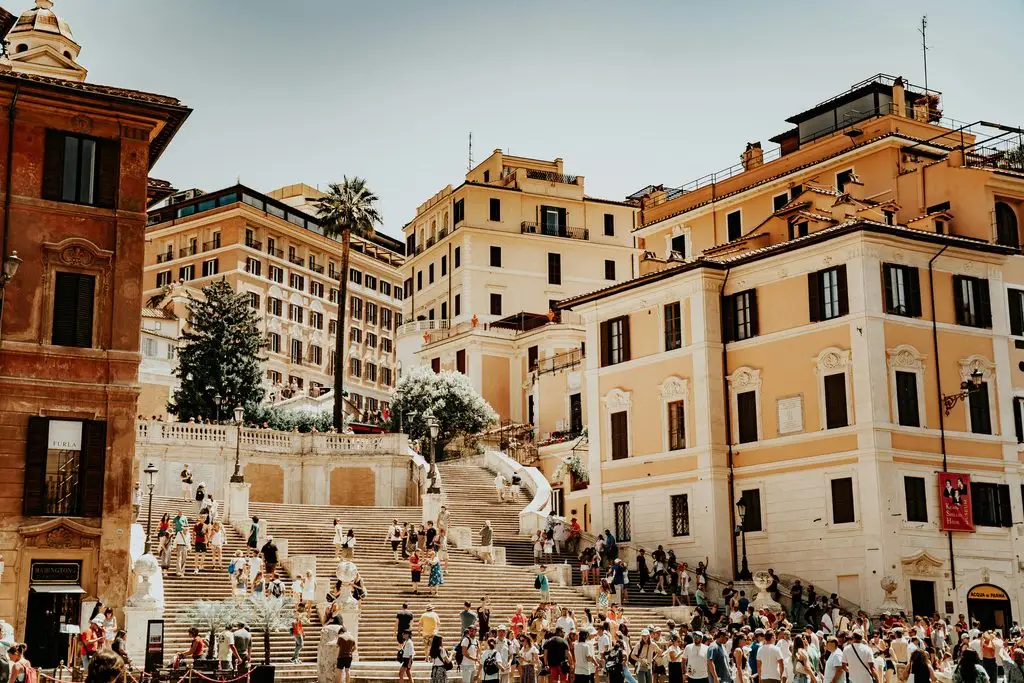
The Spanish Steps, packed with visitors on a sunny afternoon.
Can You Fit a Rome Trip Into a Teacher’s Spring Break?
Yes. A week-long spring break is enough for Rome at a relaxed pace, with a day or two left over. Four days cover the city well, and a longer break gives you room for a day trip or simply more time in Trastevere.
| School break | Trip idea | Why it works |
|---|---|---|
| Spring break (one week) | 4-5 days in Rome | Covers the Colosseum, Vatican, Spanish Steps, and the center without rushing |
| Spring break (10 days) | Rome plus Tivoli, Florence, or Pompeii | Adds a day trip without overpacking the trip |
| Shorter break (4-5 days) | Rome only, skip the day trip | Still enough for the essentials if you fly in and out efficiently |
Teacher tip: Book the Vatican and Colosseum tickets the moment your break is confirmed. Spring is peak season, and same-week tickets can sell out.
Want this mapped to your real calendar? Try my Teacher Break Trip Planner.
FAQs: Spring Break in Rome
Q: How many days do you need for spring break in Rome?
A: Four days cover the major sights without rushing. Five days lets you add Trastevere time or slow the pace. A week gives room for a day trip.
Q: What’s the best neighborhood to stay in for a first trip to Rome?
A: Trastevere, Centro Storico, or Monti all put you within walking distance of the major sights. Trastevere has an easy, local feel; Centro Storico is the most central.
Q: What food should I try in Rome?
A: The four classic Roman pastas: cacio e pepe, carbonara, amatriciana, and gricia. Each uses pecorino cheese as its base, with small variations.
Q: Is spring a good time to visit Rome?
A: Yes, though it’s a busy season. Book major sights like the Colosseum and Vatican Museums online in advance to avoid long lines.
Q: What should I wear to the Vatican?
A: Shoulders and knees covered, for both men and women. No sleeveless tops, shorts, or short skirts. A light scarf is an easy fix if your outfit doesn’t already meet the rule.
Q: Is Rome walkable, or do I need to use public transit?
A: Mostly walkable. The historic center is compact, and walking is often faster than the metro, which only has two main lines.
Q: What are the most common tourist mistakes in Rome?
A: Skipping advance tickets for the Vatican and Colosseum, falling for street vendors near major sights, and eating at restaurants with photo menus right outside landmarks.
Q: Do I need a separate ticket for Vatican City, or just the Vatican Museums?
A: St. Peter’s Square and St. Peter’s Basilica are free and need no ticket. The Vatican Museums and Sistine Chapel require a separate paid ticket, best booked online in advance.
Q: What’s the easiest day trip from Rome?
A: Tivoli, under an hour each way by train. Florence and Pompeii are both doable but take a bigger bite out of your day.
Q: Can I do a day trip from Rome during a week-long spring break?
A: Yes, if your break runs closer to 10 days. Tivoli, Florence, and Pompeii are all reachable by train, though a shorter break is better spent fully in Rome.
Ready to Plan Your Spring Break in Rome?
Four days, a few classic pastas, and one meal worth planning around. Rome doesn’t need a complicated itinerary — just good shoes and an appetite.
If you want help fitting this into your actual school calendar, my Teacher Break Trip Planner does the planning for you. Get the Teacher Break Trip Planner
Last updated: September 2026