
Want to teach English in Portugal? Here’s what the job market, salary, visa process, and daily life actually look like for US teachers.
If Spain feels too crowded and Italy feels too bureaucratic, teaching English in Portugal might be exactly what you are looking for.
Portugal has quietly become one of Europe’s most desirable destinations for teaching abroad — warm weather, stunning coastline, affordable living, and a culture that genuinely embraces a slower pace of life. The English-teaching market is smaller than in Spain or Italy, but less saturated, which means motivated students and real opportunities.
This guide covers everything US teachers need to know before they go — the job market, salary, visa process, and what daily life in Portugal actually looks like.

Lisbon’s famous yellow trams are part of everyday life when you teach English in Portugal — one of Europe’s most beautiful and livable cities.
The English Teaching Job Market in Portugal
Portugal’s demand for English is growing rapidly, driven by EU membership, a booming tech sector in Lisbon, and a thriving tourism industry. The market is smaller than Spain or Italy, but significantly less competitive — a genuine advantage for teachers who want engaged students and a real foothold in the European teaching market.
Private language schools are the primary employers. Schools in Lisbon and Porto hire qualified English teachers year-round, with demand strongest in the autumn and spring terms.
Corporate Business English is a growing sector. Lisbon’s expanding tech industry and international business community drive strong demand for professional English training — and corporate clients typically pay more than language school rates.
International schools in Lisbon follow IB and Cambridge curricula and require full teaching credentials. These are competitive but offer excellent packages for credentialed US teachers.
The difference between international schools and language schools before you apply
Where Should You Teach in Portugal?
Lisbon is Portugal’s primary teaching market — with strong demand for Business English, a growing international school sector, and the largest expat community in the country. The cost of living has increased significantly in recent years, but it remains below that in Madrid or Rome.
Porto is Portugal’s second city and a beautiful base for exploring northern Portugal and Spain. The language school market is smaller, but the cost of living is significantly lower, and the atmosphere is charming and less touristy than Lisbon.
Smaller cities, including Coimbra, Braga, and Faro, offer a more immersive Portuguese experience with lower costs. Teaching opportunities are more limited, but competition is lower as well.
What Qualifications Do You Need to Teach English in Portugal?
For language school positions in Portugal, you need a TEFL or CELTA certification of at least 120 hours and, in most cases, a bachelor’s degree. Corporate Business English work requires the same credentials plus self-employment registration.
An honest review of Bridge TEFL, one of the most recognized online certification programs
International school positions require a full state teaching license and typically two to five years of classroom experience — but offer housing allowances and competitive salaries in return.
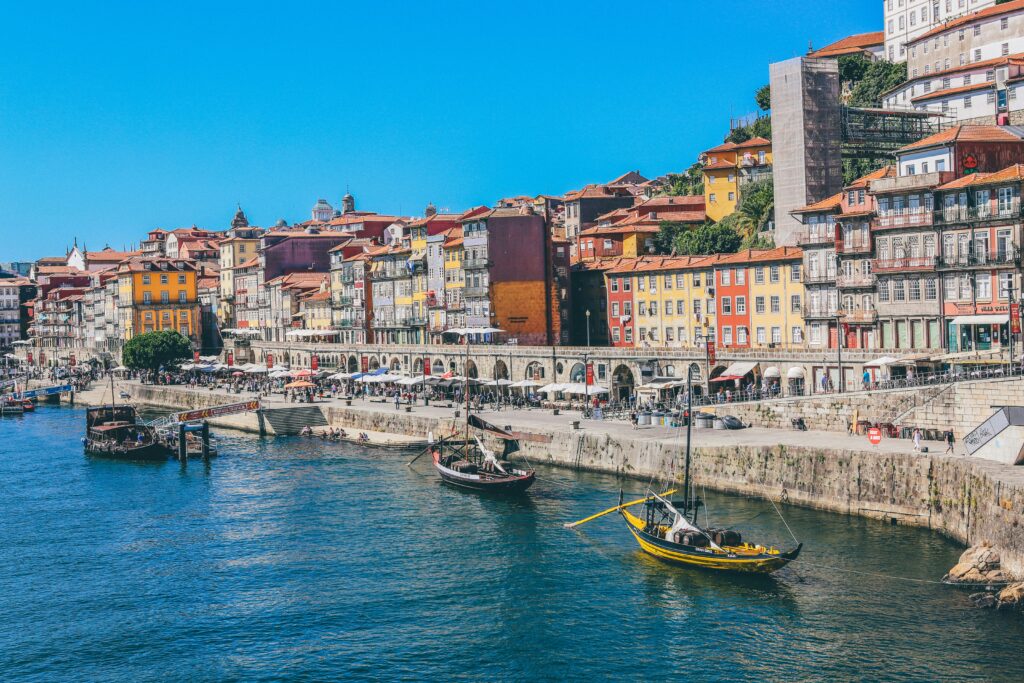
Porto’s Ribeira district — one of the most beautiful waterfronts in Europe and a fantastic base for teachers who choose to teach English in Portugal.
Salary and Savings: What Can You Actually Earn in Portugal?
Teaching English in Portugal pays 1,000 to 1,600 dollars per month — lower than Prague or Vienna, but the lifestyle and weather more than compensate for many teachers.
| Position | Monthly Earnings (USD) |
|---|---|
| Language school teacher (Lisbon) | $1,000 – $1,600 |
| Language school teacher (Porto) | $900 – $1,400 |
| Corporate Business English | $1,500 – $2,500 |
| International school teacher | $2,000 – $3,500 + benefits |
Monthly cost of living in Portugal:
| Expense | Lisbon (USD) | Porto (USD) |
|---|---|---|
| Rent (shared flat) | $600 – $900 | $400 – $650 |
| Groceries | $200 – $300 | $180 – $250 |
| Transport pass | ~$40 | ~$30 |
| Dining out | $120 – $200 | $100 – $160 |
| Total estimate | $1,000 – $1,400 | $700 – $1,000 |
Bottom line: Savings are minimal for language school teachers in Lisbon. Porto and smaller cities offer a more comfortable margin. Corporate English trainers and international school teachers can save meaningfully. Teachers who eat at tascas, shop at markets, and use public transport consistently find that their salaries go further than expected.
The Visa Process for US Teachers in Portugal
US citizens need a Portuguese long-stay visa — called a D visa — to work legally in Portugal. EU freedom of movement does not apply to US passport holders, so securing work authorization before you arrive is essential.
The most common route is employer sponsorship. Your Portuguese employer applies for a work permit on your behalf, and you then apply for the D visa at the Portuguese consulate in the US before departure.
Portugal has also introduced a Digital Nomad Visa and a Job Seeker Visa that some teachers use as entry points — but a standard employer-sponsored work visa remains the most straightforward and legally secure route for most teachers.
On arrival, register with AIMA — the Agency for Integration, Migration and Asylum, which replaced SEF (Serviço de Estrangeiros e Fronteiras) in 2023 — within three months. You will also need to obtain your NIF (Número de Identificação Fiscal — Portuguese tax identification number) for banking, contracts, and any financial transactions in Portugal.
Protecting your US teaching position before you commit to anything abroad
What Is Daily Life Like Teaching English in Portugal?
Daily life in Portugal is genuinely extraordinary — warm, unhurried, and beautiful in a way that recalibrates most teachers permanently within a few months of arriving.
Portugal has a way of slowing you down and making you grateful for it. Life moves at a pace that feels genuinely different from the US and from most of Northern Europe. The Portuguese concept of saudade — a melancholic longing for beauty, warmth, and connection — permeates daily life in a way that is hard to describe until you have experienced it.
The schedule runs on Mediterranean-adjacent time. Lunch is a proper sit-down affair, often lasting an hour or more. Dinner starts around 8 pm. Weekends are long and unhurried. A bica (Portuguese espresso) at a pastelaria counter for under a euro is one of the great small pleasures of daily life.
The weather is one of Portugal’s strongest arguments. Lisbon averages 300 days of sunshine per year. [EXTERNAL LINK: https://www.ipma.pt/en/index.html — according to IPMA, Portugal’s national meteorological authority, Lisbon is one of Europe’s sunniest capitals] Winters are mild, rarely dropping below 10 degrees Celsius. Summers are warm, without the extreme heat of southern Spain or Greece, and are cooled by Atlantic breezes.
The people are warm but initially reserved. Friendships take time to build, but once established, are genuine and lasting. Learning even a few Portuguese phrases transforms how locals respond to you almost immediately.
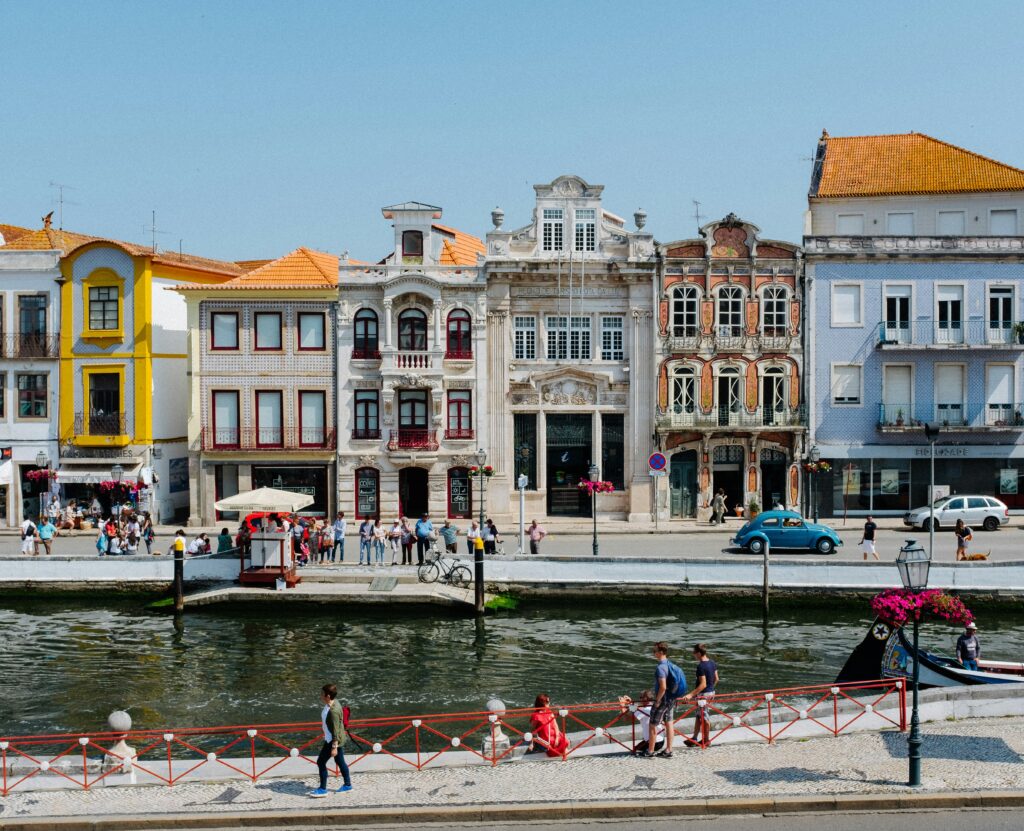
Aveiro — one of Portugal’s most charming smaller cities, and just one of the beautiful places within easy reach when you teach English in Portugal.
Food in Portugal on a Teacher’s Budget
Portuguese food is one of Europe’s most underrated cuisines — simple, fresh, and deeply satisfying, and far more affordable than most Western European countries.
A full meal at a local tasca runs 8 to 12 euros with wine included. The menu do dia (daily lunch menu) — typically soup, a main course, and dessert or coffee — costs 7 to 10 euros and is one of the best value meals in Europe.
Portugal’s national obsession is bacalhau (salt cod), prepared in hundreds of different ways. Francesinha is Porto’s legendary sandwich — layers of meat and sausage smothered in a spiced tomato-and-beer sauce. Pastel de nata (Portuguese custard tart) from a good pastelaria is one of the world’s great baked goods, best eaten warm with cinnamon and a bica alongside.
Teachers who eat like locals spend significantly less than their salary might suggest — and eat extraordinarily well in the process.
Weekend Travel from Portugal
Portugal’s location on the southwestern tip of Europe provides remarkable weekend travel access — from Moroccan medinas to Spanish cities to Atlantic island escapes.
| Destination | Travel Time |
|---|---|
| Sintra | 40 mins by train from Lisbon |
| Algarve coast | 3 hours by bus/train |
| Douro Valley | 1 hour from Porto |
| Seville, Spain | 2.5 hours by bus from Lisbon |
| Madrid | 2.5 hours by bus or 1 hour by flight |
| Morocco | 2 hours by budget flight from Lisbon |
| Azores | Budget flight from Lisbon |
Morocco, in particular, is a two-hour budget flight from Lisbon — one of the most dramatic cultural contrasts available from any European teaching base. The Azores and Madeira, both accessible by budget flight, feel genuinely unlike anywhere else on earth.
[INTERNAL LINK: https://www.travelandteachabroad.com/teach-english-in-prague-czech-republic/ — “teaching English in Prague if you want to compare European city options”]
The Honest Challenges of Teaching in Portugal
Portugal is extraordinary — but US teachers should go in with clear eyes about three real challenges.
Savings are limited in Lisbon. The capital has become significantly more expensive in recent years as its popularity with digital nomads and international workers has grown. Language school teachers in Lisbon will cover expenses comfortably but save modestly. Porto and smaller cities offer a better financial margin.
The D visa process requires planning. Employer-sponsored work authorization takes time — start the process early and do not plan to arrive and sort it out on the ground. Portugal’s bureaucracy, while generally manageable, moves at its own pace.
European Portuguese is genuinely hard. Faster and more clipped than Brazilian Portuguese, with sounds that have no English equivalent. Most young Portuguese in cities speak excellent English — but learning the language transforms your experience of the country entirely.

Lisbon’s famous azulejo tiles — the hand-painted ceramic tiles that cover buildings across the city are one of the most distinctive parts of daily life when you teach English in Portugal.
FAQs: Teaching English in Portugal
Q: Do I need a TEFL certificate to teach English in Portugal?
A: Yes — for language school positions in Portugal, a TEFL or CELTA certification of at least 120 hours is standard. A bachelor’s degree is also typically required for legal work authorization. Bridge TEFL offers an accredited online program you can complete before leaving the US.
Q: How much do English teachers earn in Portugal?
A: Language school teachers earn approximately $1,000–$1,600 per month in Lisbon and $900–$1,400 in Porto. Corporate Business English trainers earn $1,500–$2,500 depending on client load. Savings are modest for language school teachers in Lisbon but more achievable in Porto and smaller cities.
Q: Can US citizens teach English in Portugal legally?
A: Yes — but US citizens need a Portuguese D visa and work authorization. EU freedom of movement does not apply. The most common route is employer sponsorship. On arrival, register with AIMA within three months and obtain your NIF tax identification number.
Q: Is Portugal expensive for English teachers?
A: Lisbon has become significantly more expensive in recent years. A comfortable lifestyle costs $1,000–$1,400 per month in the capital. Porto is considerably more affordable at $700–$1,000 per month. Teachers who eat at tascas and use public transport find their salary goes further than expected.
Q: Why do teachers love Portugal so much?
A: The combination of warm weather, extraordinary food, Atlantic beaches, affordable lifestyle, and a genuinely slower pace of life is hard to replicate anywhere else in Europe. Teachers who go for one year frequently stay for two, and most describe it as permanently recalibrating their sense of what daily life can feel like.
Is Portugal Right for You?
Portugal is not the loudest teach abroad destination — it does not have South Korea’s financial packages or Spain’s name recognition. But teachers who choose Portugal consistently say the same thing: they underestimated how much they would love it.
The scenery, the food, the people, the pace — Portugal has a way of getting under your skin quietly and staying there long after you come home.
If Portugal sounds like your place, start here.