
Want to teach English in Thailand? Here’s the real picture on jobs, salary, cost of living, visa, and what daily life actually looks like.
Thailand has been one of the world’s most popular destinations for first-time English teachers for decades — and it earns that reputation every year.
Low cost of living. Warm culture. Extraordinary food. A teaching market that welcomes newcomers without requiring years of experience or an advanced degree. And Southeast Asia is right outside your door every weekend.
Teaching English in Thailand is genuinely accessible — lower barriers to entry than almost any other destination, with salaries that stretch remarkably far once you factor in the cost of living. Government school teachers earn $800–$1,100 USD per month. Private school and language school teachers earn $1,000–$1,600. And a comfortable lifestyle in Bangkok runs $700–$1,000 per month — which means real savings are possible, especially outside the capital.
What Thailand is not: Europe. If living on the continent matters to you, see our full comparison of the best countries to teach abroad for European alternatives. If you’re open to Southeast Asia — and you should be — read on.
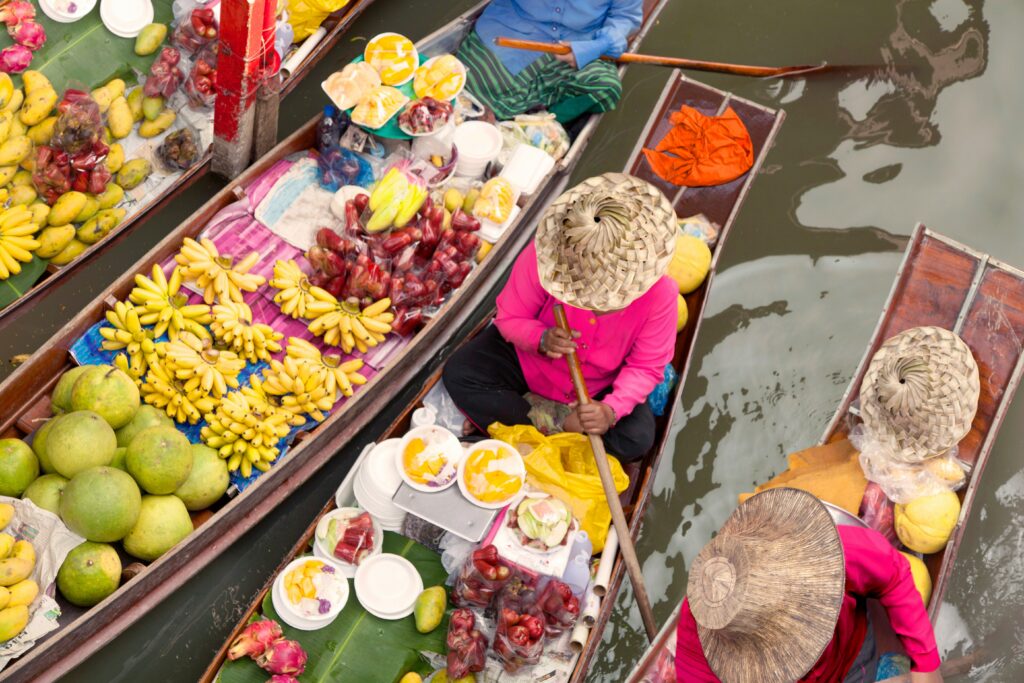
The floating markets near Bangkok are a weekend trip that never gets old.
Where Are the English Teaching Jobs in Thailand?
Thailand has four main types of English teaching positions, each with different requirements, pay, and daily experience.
Government schools are the most common placement for first-time teachers. Salaries run 30,000–40,000 Thai baht per month (~$800–$1,100 USD). Positions are stable, and the experience is genuine — you’re embedded in a Thai school community, not a tourist bubble.
Private and international schools pay significantly better — 40,000–80,000 baht — but are more competitive to enter, typically requiring teaching credentials and prior classroom experience.
Language schools and TEFL academies are the most accessible for teachers without experience. Hours can be irregular, with evening and weekend classes common, but they’re a solid entry point.
University positions require a master’s degree, are competitive, but offer excellent working conditions and the most professional environment.
What Do English Teachers Earn in Thailand?
English teachers in Thailand earn 30,000–60,000 Thai baht per month ($800–$1,600 USD), with significant variation based on school type and location.
The cost-of-living context makes these numbers meaningful. A comfortable furnished apartment in Bangkok runs $300–$500 USD per month. Street food meals cost $1–$3. A month of comfortable living in Bangkok — accommodation, food, transport, social life — costs $700–$1,000. Outside Bangkok, the same lifestyle costs $500–$700.
Teachers at government schools in smaller cities who live simply often save $300–$500 per month. Teachers at private international schools in Bangkok can save $500–$800 or more. Thailand is not on a South Korea-level savings track, but it’s genuinely possible — especially if you resist the temptation to live like a tourist rather than a resident.
Bangkok vs. Chiang Mai: Which City Should You Choose?
The choice between Bangkok and Chiang Mai shapes your entire experience in Thailand — they are genuinely different ways of living.
Bangkok is one of the world’s great cities — chaotic, enormous, endlessly stimulating, and full of every comfort a foreign teacher could want. Most jobs are here, which is why most first-time teachers land here. The food is world-class and extraordinarily cheap. The BTS Skytrain elevated rail network makes the city navigable. The traffic is legendary. Bangkok regularly hits 35–40°C (95–104°F) from March through May.
Chiang Mai in Thailand’s north is smaller, cooler, more relaxed, and deeply loved by the foreign teacher community. A city of temples, night markets, and café culture that feels genuinely livable. The cost of living is lower than in Bangkok. The expat community is tight-knit and welcoming. Many teachers who start in Bangkok migrate north within a year or two. According to Numbeo’s Chiang Mai cost of living data, monthly expenses run $500–$700 for a comfortable lifestyle — significantly lower than in Bangkok.
Coastal placements near Phuket or Koh Samui exist but are more limited, seasonal, and harder to secure as a first posting.
| Location | Monthly Cost | Job Market | Pace |
|---|---|---|---|
| Bangkok | $700–$1,000 | Strong — most jobs | Fast, stimulating |
| Chiang Mai | $500–$700 | Moderate | Slower, livable |
| Coastal (Phuket/Koh Samui) | $600–$900 | Limited, seasonal | Resort-oriented |
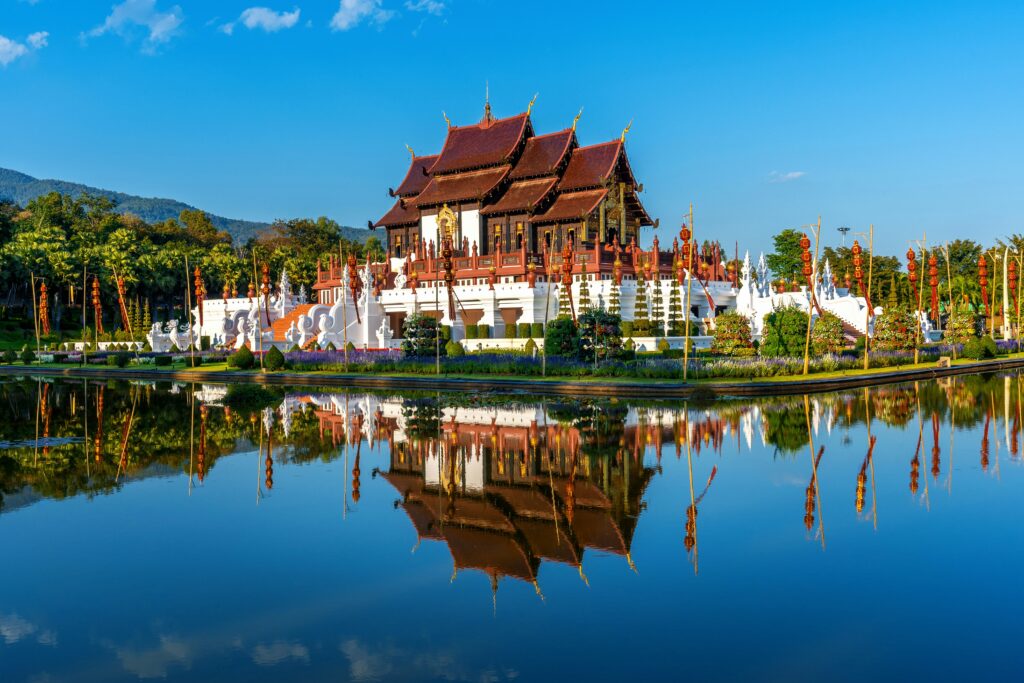
Chiang Mai rewards the teachers who choose it. This is why.
What Qualifications Do You Need to Teach English in Thailand?
Most English teaching positions in Thailand require a TEFL certificate of at least 120 hours and a bachelor’s degree for a legal work permit.
The TEFL certificate — a Teaching English as a Foreign Language certification, typically completed online or in-person over 4–8 weeks — is the baseline credential for most language school and government school positions. Our guide to in-person TEFL courses compares online vs in-person certification options if you’re deciding between the two.
The bachelor’s degree requirement is tied to Thai immigration law — specifically the Non-Immigrant B visa (Thailand’s standard work visa for teachers), which legally requires a degree. Some language schools hire teachers without degrees on tourist visa runs, but this is legally precarious and not a sustainable long-term arrangement. If you’re planning to stay a full year and work legally, a bachelor’s degree is effectively required.
The Thailand Work Visa: What You Need to Know
Getting a legal work permit in Thailand as a foreign English teacher requires a Non-Immigrant B visa, a work permit issued by the Thai Ministry of Labor, and sponsorship from your school.
The process is simpler than for European visas but has its own quirks. Most teachers arrange their visas through their schools; reputable employers handle the work permit process and are familiar with the requirements. The key documents typically include your passport, a bachelor’s degree (apostilled or notarized), a TEFL certificate, a criminal background check, and a medical certificate.
The [EXTERNAL LINK: Thai Embassy’s work permit overview covers current requirements. Requirements and processing times do change — always verify with your specific employer and the nearest Thai consulate before applying.
One important note: Some teachers enter on tourist visas and do “visa runs” to neighboring countries to extend their stay without a work permit. This is technically illegal for paid work and carries real risk. A legal arrangement through a reputable school is always the better path.
What Does Daily Life Actually Look Like When You Teach English in Thailand?
Daily life as an English teacher in Thailand is genuinely different from anything most Western teachers have experienced — and most describe the adjustment as one of the most rewarding of their lives.
Thai culture places enormous value on sanuk (fun), mai pen rai (a phrase roughly meaning “never mind, it’s okay”), and maintaining a pleasant social atmosphere. Confrontation is avoided. Warmth toward foreigners is genuine and immediate. The adjustment to daily life in Thailand is often easier than in more reserved cultures, precisely because the social environment is so welcoming.
Thai schools have their own rhythms. Respect for hierarchy is fundamental — the teacher-student relationship is more formal and reverential than most American teachers expect. Wai-ing (the traditional Thai greeting, hands pressed together at the chest) students and colleagues is expected and appreciated. Flexibility is not optional. School events, ceremonies, and cultural activities regularly reshape the schedule, requiring genuine adaptability.
The heat is real. Bangkok hits 35–40°C from March through May. Air conditioning in schools and apartments makes it manageable, and acclimatization takes 2–3 weeks. The cool season from November through February is Thailand’s most pleasant period — warm, dry, and comfortable.
Thai Food: One of the Great Perks of Teaching English in Thailand
Thai food is one of the world’s great cuisines — and eating it in Thailand, where it’s fresh, cheap, and available on every corner, is one of the defining pleasures of living there.
Street food is the foundation of most teachers’ daily eating. A plate of pad thai from a street vendor runs 50–80 baht ($1.50–$2.50). Som tam (green papaya salad) is pounded to order. Grilled chicken (gai yang) from a charcoal grill. Mango sticky rice for under $2. Monthly food costs of $100–$200 for three meals a day of excellent Thai food are entirely achievable — and represent one of the most dramatic contrasts with the cost of eating in the US.
Tom yum (hot-and-sour soup with lemongrass, galangal, and kaffir lime leaves) and tom kha (the same aromatics in rich coconut milk) are eaten as part of shared meals, not starters. Green curry (gaeng keow wan) is fiery and aromatic. Massaman curry — richer, Persian and Indian-influenced, made with potato, peanuts, and coconut milk — is deeply comforting.
Regional variation is one of the great rewards of a full year in Thailand. Northern Thai food, centered on Chiang Mai, features khao soi (coconut curry noodle soup) and sai ua (Northern Thai sausage), rarely found in Bangkok. Southern Thai food is spicier and more coconut-heavy, reflecting proximity to Malaysia.

Railay Beach, Krabi — only accessible by boat, and worth every minute of the journey.
Weekend Travel in Thailand: Where to Go When School’s Out
Thailand is one of the world’s great weekend travel destinations — and living there as a teacher means you have access to all of it on a local’s budget.
Within Thailand alone, the options are extraordinary. Here are the destinations worth prioritizing during your year there.
Krabi and Railay Beach are among the most spectacular places in Southeast Asia. Krabi town is the jumping-off point for the region — a two-hour flight from Bangkok or an overnight bus. From Krabi, you take a longtail boat to Railay Beach, a peninsula only accessible by water, surrounded by dramatic limestone karst cliffs, turquoise water, and white sand. It’s the kind of place that genuinely looks like the photos. The main activities are rock climbing, kayaking, and simply sitting on the beach with a fresh coconut. Krabi and Railay Beach were the highlights of my time in Thailand.
Phuket is Thailand’s largest island and the country’s most developed tourist destination. Patong Beach is busy and commercial — skip it unless that’s your scene. Kata Beach and Kata Noi on the south end of the island are calmer, more beautiful, and worth the extra 20 minutes in a taxi. Phuket Town itself has genuinely excellent food and a distinct Sino-Portuguese architectural character that most tourists miss entirely. Phuket is best as a base for island-hopping — Phi Phi Island and the Similan Islands are both accessible by day trip.
Pai is a small mountain town in northern Thailand, about three hours by winding road from Chiang Mai. It has a reputation as a backpacker hub, but the surrounding landscape — rice fields, hot springs, waterfalls, and mist over the mountains in the early morning — is genuinely beautiful. Teachers based in Chiang Mai frequently make this trip. Go in the cool season (November through February) for the best weather.
Chiang Rai is northern Thailand’s second city and home to the White Temple (Wat Rong Khun) — one of the most striking modern temples in Asia. The Golden Triangle, where Thailand, Laos, and Myanmar meet at the Mekong River, is a short drive away. A long weekend from Chiang Mai covers it comfortably.
Koh Lanta is a quieter, more laid-back alternative to Phuket or Koh Samui — a long island in the Andaman Sea with good beaches, excellent seafood, and a noticeably slower pace. Popular with teachers who’ve done the bigger islands and want something more relaxed.
Koh Samui and the Gulf of Thailand islands — Koh Tao (the best diving in Thailand) and Koh Phangan (beyond the Full Moon Party, genuinely beautiful) — are accessible from Bangkok by overnight train and ferry, making them solid long-weekend destinations.
Ayutthaya, the ancient former capital of Thailand, is just 1.5 hours north of Bangkok by train and is one of the most historically significant sites in Southeast Asia. Temples, Buddha statues, and ruins spread across an island in the river — completely doable as a day trip from Bangkok.
Beyond Thailand: Southeast Asia at Your Doorstep
Beyond Thailand, Southeast Asia opens up from your doorstep. Vietnam, Cambodia, Laos, Malaysia, and Indonesia are all reachable by budget flights for under $100 USD round-trip on AirAsia and Lion Air. The slow overnight train from Bangkok to Chiang Mai is one of Asia’s great journeys. The bus border crossing from Chiang Mai into Laos is a classic teacher weekend adventure.
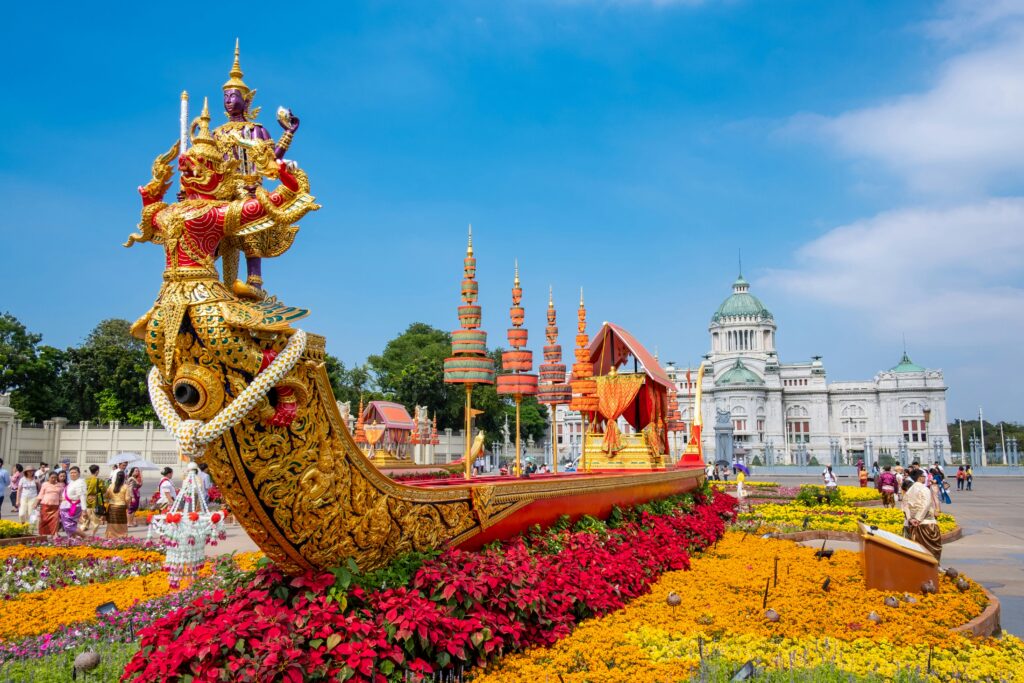
Bangkok doesn’t do anything small. This is the Ananta Samakhom Throne Hall during a royal ceremony — one of the many moments that reminds you exactly where you are.
For US Teachers: Protecting Your Career While You’re Gone
If you’re a licensed US teacher, sort out your leave of absence before you commit to anything in Thailand. Most US school districts offer a personal leave of absence—a formal arrangement that allows tenured teachers to step away for 1–3 years and return to their positions with tenure and pension protections intact.
The conversation with HR is simpler than most teachers expect. Our guide on how to take a leave of absence from your US teaching job covers exactly how to approach it and what to get in writing before you leave.
FAQs: Teaching English in Thailand
Q: How much do English teachers make in Thailand?
A: English teachers in Thailand earn 30,000–60,000 Thai baht per month ($800–$1,600 USD) depending on school type and location. Government school teachers earn on the lower end; private international school teachers, on the higher end. Cost of living is low enough that savings are possible at most salary levels, especially outside Bangkok.
Q: Do I need a TEFL certificate to teach English in Thailand?
A: Yes — most language schools and government school positions require a TEFL certificate of at least 120 hours. A bachelor’s degree is also required for a legal Non-Immigrant B work visa. Some schools hire without a degree, but legal working status requires both credentials.
Q: Is Bangkok or Chiang Mai better for teaching English in Thailand?
A: It depends on what you’re optimizing for. Bangkok has more jobs, more stimulation, and a higher cost of living. Chiang Mai has a slower pace, lower costs, a beloved expat community, and is consistently rated as more livable. Many teachers start in Bangkok and migrate to Chiang Mai. Both are excellent bases.
Q: What is the cost of living for English teachers in Thailand?
A: A comfortable lifestyle in Bangkok runs $700–$1,000 USD per month, including accommodation, food, transport, and social life. In Chiang Mai and smaller cities, the same lifestyle costs $500–$700. Street food meals cost $1–$3, and furnished apartments run $300–$500 in Bangkok and less elsewhere.
Q: Can I save money teaching English in Thailand?
A: Yes — savings are genuinely possible, particularly at private school salary levels and outside major cities. Government school teachers in Bangkok often break even or save minimally. Teachers at private international schools earning 50,000–80,000 baht can comfortably save $300–$600 per month. Living like a resident rather than a tourist makes a significant difference.
Is Thailand the Right Move for You?
Thailand is the right choice if you want the lowest barrier to entry, a warm and welcoming culture, extraordinary food, and Southeast Asia right outside your door. It’s genuinely accessible, daily life is rich, and weekend travel from your base is unlike anything available at any other teaching destination on earth.
Thailand is not the right choice if living in Europe is important to you, or if you need a high level of professional structure from day one. The heat, the language barrier, and the cultural adjustment are real — and they’re worth it.
Teachers who embrace Thailand rather than resist it consistently describe it as the most transformative experience of their lives. Go in prepared, legal, and with realistic expectations — and it delivers.
The Ultimate Teach Abroad Toolkit covers Thailand alongside every other major destination — salary data, visa details, packing lists, and job search strategy all in one place.
Not ready for the full toolkit? Start with the free checklist.