
This post contains affiliate links. If you purchase through my links I may earn a small commission at no extra cost to you.
Split crept up on me.
I expected to be dazzled by Dubrovnik, blown away by the islands, and moved by Plitvice. And I was. But Split — the city itself, the ancient mess of it, the fact that people actually live and do their laundry inside a Roman emperor’s palace — was the one that got under my skin in a way I didn’t see coming.
It’s also one of the most extraordinary bases for weekend travel in Europe, and most teachers who end up here realize it within their first week. The best weekend trips from Split stretch in both directions along the Dalmatian coast. Hvar is under 2 hours by ferry. Dubrovnik is 3 hours south by bus. Plitvice Lakes — one of Europe’s most extraordinary national parks — is 3 hours north. And Bosnia’s Mostar is just 2.5 hours away, which sounds close until you realize you’re crossing into an entirely different world.
Whether you’re planning a quick day trip or a full weekend away, Split puts some of Europe’s most extraordinary destinations within easy reach.
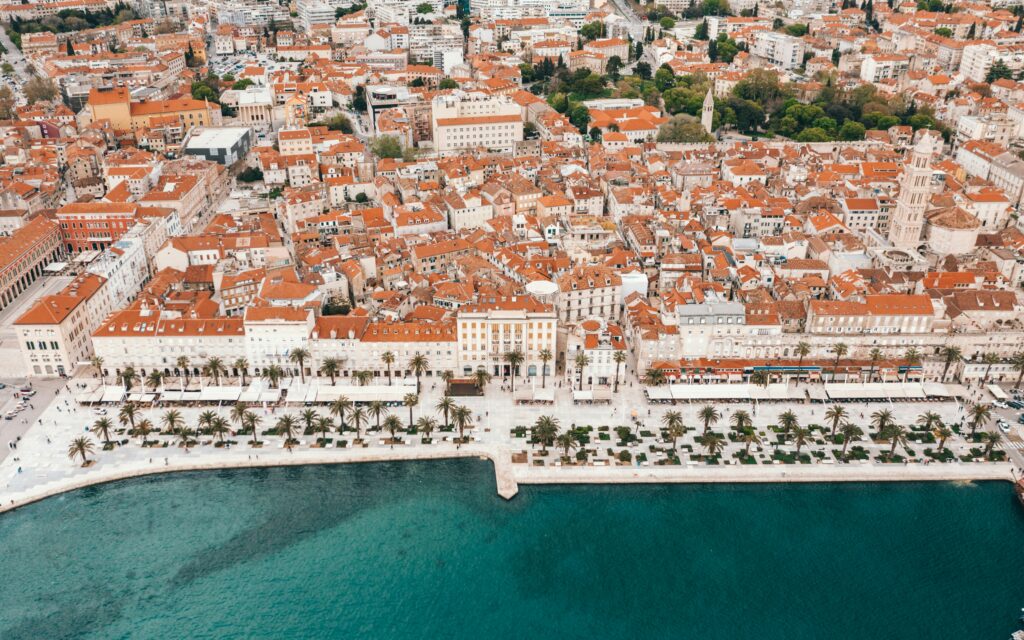
Split from above — the Riva promenade, Diocletian's Palace, and the Adriatic. One of Europe's most extraordinary bases for weekend travel.
Islands from Split: Ferries with Jadrolinija
Hvar (1 to 2 hours by ferry) is Croatia’s most glamorous island — and it earns the reputation, though not always in the way you’d expect.
Hvar Town gets the headlines: the 16th-century Venetian fortress above the harbor, the marble-paved main square, and the boats moored along the waterfront, ranging from fishing dinghies to superyachts. In summer, it can feel crowded and party-coded. But the rest of the island — lavender fields stretching toward the hills, the quiet medieval village of Stari Grad, the Pakleni islands offshore accessible by water taxi — is completely different. Peaceful, beautiful, genuinely extraordinary.
Don’t just stay in the harbor. Get out to the island, and it becomes one of the best places in Europe. Jadrolinija catamaran from Split to Hvar Town runs approximately 1 hour. The car ferry to Stari Grad runs approximately 2 hours.
Brač (50 minutes by ferry) is my personal favorite — and once you get there, you’ll understand why.
Zlatni Rat is Croatia’s most photographed beach for good reason: a long, narrow spit of white pebbles that actually shifts direction with the current, jutting into impossibly clear water. It’s one of those places that looks exactly like the photos and still manages to exceed them.
But Brač is more than one beach. The island’s white limestone was used to build Diocletian’s Palace right there in Split — and reportedly the White House in Washington. There’s something quietly extraordinary about standing on an island that literally shaped both a Roman emperor’s home and an American landmark.
The car ferry from Split to Supetar runs approximately 50 minutes. Don’t miss it.
Vis (2.5 hours by ferry) is Croatia’s best-kept secret — and teachers who find it tend to come back.
The most remote of the main Dalmatian islands, Vis didn’t open to tourism until 1989 — it was a closed military zone until then. That late start shows in the best possible way: quieter, more authentic, less developed than Hvar or Brač. The wine is extraordinary (Vugava white and Plavac Mali red), the fish restaurants in Vis Town and Komiža are among the best on the coast, and the Blue Cave on the nearby islet of Biševo — a sea cave that glows electric blue when sunlight hits the water — is one of those things you’ll spend years trying to describe to people who haven’t seen it.
Jadrolinija ferry from Split runs approximately 2 hours and 30 minutes. Worth every minute.
👉 Ready to see many in one day? This 5-island boat tour from Split covers Hvar, Vis, Brač, the Pakleni Islands, and the famous Blue Cave — 10.5 hours, 4.9 stars, and one of the most popular tours on the Dalmatian coast.
Korčula (3 hours by catamaran) looks like a miniature Dubrovnik — and has a fraction of the crowds.
A medieval old town on a small peninsula jutting into the sea, Korčula is compact, beautiful, and easy to fall in love with. It’s the alleged birthplace of Marco Polo, though the Venetians dispute this with characteristic passion. The local wines — Grk and Pošip, both grown on the island — are among Croatia’s finest. The streets are narrow and car-free and quiet in the evenings in a way that Dubrovnik almost never is anymore.
Jadrolinija catamaran from Split runs approximately 3 hours.
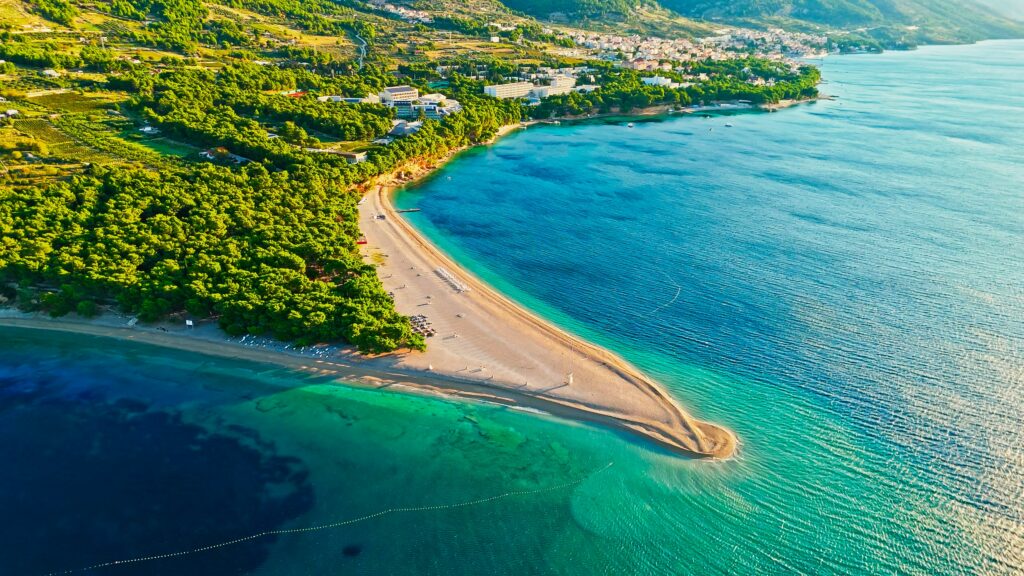
Zlatni Rat — Croatia’s most photographed beach, on the island of Brač. Just 50 minutes by ferry from Split and absolutely worth it.
Mainland Destinations from Split
Dubrovnik (3 hours by bus) has a medieval old town with one of Europe’s most extraordinary city walls — the full circuit walk gives views of the Adriatic and the terracotta rooftops. It is extremely crowded in summer. Go in May, June, September, or October for a better experience. FlixBus or local bus from Split bus station runs approximately 3 hours, 80–150 HRK.
Fair warning: Dubrovnik in July is a different beast entirely. Go in May, September, or October if you can — the difference is night and day.
Plitvice Lakes National Park (3 hours by bus) is sixteen interconnected lakes cascading into each other through waterfalls and travertine formations — one of Europe’s most beautiful natural landscapes and a UNESCO World Heritage Site since 1979. Go in spring or autumn for the best colors and manageable crowds. Book tickets in advance online — the park fills up on summer weekends. The bus from Split runs approximately 3 hours.
👉 Planning a day trip to the lakes? This guided Plitvice Lakes day trip from Split takes care of all the logistics so you can just show up and be amazed.
Mostar, Bosnia and Herzegovina (2.5 hours by bus) has the Stari Most — the restored 16th-century Ottoman bridge over the Neretva river — as its centerpiece, but the entire old town is extraordinary. The bazaar, the minarets, the extraordinary setting in a river gorge. Bosnia is a different world from Croatia — slower, cheaper, and deeply worth experiencing. The bus from Split bus station takes approximately 2 hours and 30 minutes and costs under 20 euros.
Practical Tips for Weekend Trips from Split
Book Jadrolinija ferries in advance for summer. The island ferries from Split fill up on summer weekends — particularly for Hvar and Vis. Book online at jadrolinija.hr or through the Jadrolinija app. Car spaces sell out weeks in advance during peak season; foot passengers have more flexibility.
Travel carry-on only. Ferry and bus travel in Croatia is much easier with a single 40-liter backpack. Our packing guide for teachers abroad covers exactly what to bring.
Croatia uses the euro (since 2023). Croatia joined the eurozone on 1 January 2023, replacing the kuna with the euro. This makes weekend travel from Split to Slovenia and Montenegro simpler. Bosnia uses the Bosnian convertible mark (BAM), pegged to the euro at 1 EUR = 1.96 BAM.
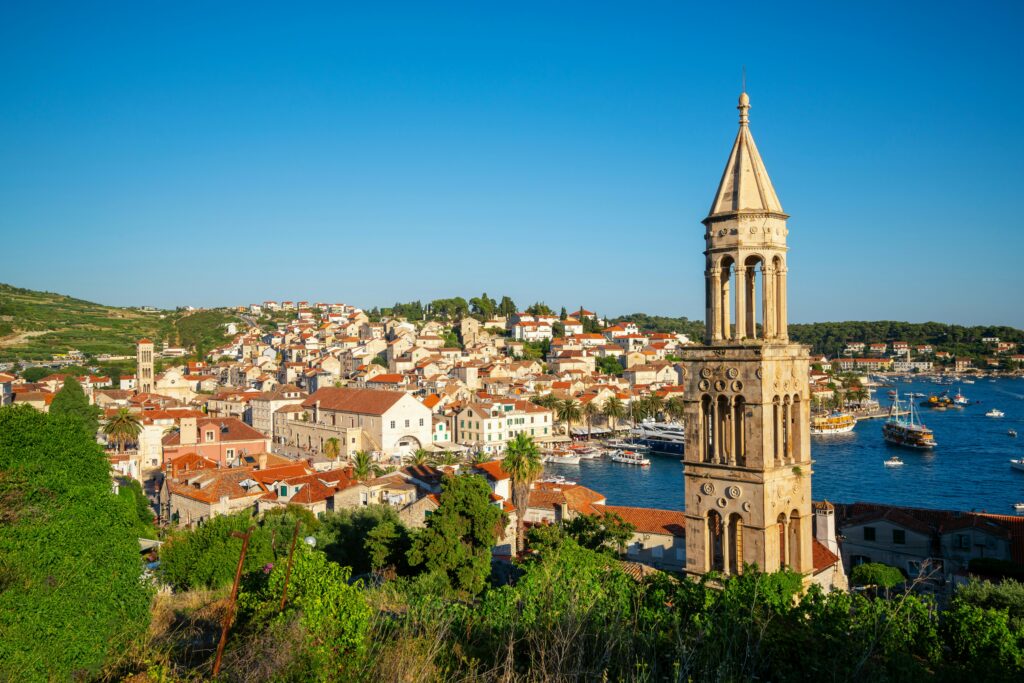
Hvar Town from above — the harbor, the bell tower, and the Adriatic beyond. Just 1 hour by catamaran from Split.
FAQs: Weekend Trips from Split
Q: What is the best island to visit for a weekend trip from Split?
A: Hvar is the most popular and most rewarding — beautiful old town, extraordinary water, and the right balance of liveliness and quiet, depending on which part of the island you visit. For something quieter and more authentic, Vis is the best choice. For beaches, Brač (Zlatni Rat) is the most famous.
Q: Can you do Dubrovnik as a day trip from Split?
A: Yes — 3 hours by bus each way makes it a long but possible day trip. However, Dubrovnik is better as an overnight. Stay for the evening when the cruise ship day-trippers have left, and the old town becomes a completely different place.
Q: Is teaching in Croatia worth it for the lifestyle?
A: Split in particular offers an extraordinary lifestyle — beautiful old town, Adriatic beaches, island access — on a modest salary. The teaching market is small, and salaries are lower than in Western Europe, but the cost of living is also significantly lower. Our teaching abroad FAQs honestly cover the trade-off between lifestyle and salary.
Split is the kind of place that changes your sense of what normal can feel like. You teach, you travel, you eat grilled fish on a terrace above the Adriatic, and at some point, you stop counting down to weekends because the weeks are good too.
Teach in Europe Guide $17 — Get the full country guide for 7 European teaching destinations
Free Teach Abroad Checklist — Download the free checklist to start planning