What does TEFL stand for? You’ve seen the four letters on job posts, program pages, and Instagram bios. TEFL shows up everywhere once you start looking into teaching abroad, and nobody explains it.
Disclosure: This post contains affiliate links. If you buy through them, I may earn a small commission at no extra cost to you.
TEFL stands for Teaching English as a Foreign Language. A TEFL certificate is a short training course, usually 120 hours, that teaches you how to teach English to people who don’t speak it as a first language. Many language schools abroad ask for one before they’ll hire you.
I took my TEFL course in person in Prague, then taught young learners at a language school there. Below, I’ll share what the course is actually like, whether you need one, and how it compares to TESOL and CELTA.
If you already know you want an online course, I share the one I recommend in my Bridge TEFL review.
Key Takeaways
- TEFL stands for Teaching English as a Foreign Language.
- Most schools and programs look for a TEFL certificate of at least 120 hours.
- Many teaching jobs abroad ask for a TEFL, but some programs, like Spain’s language assistant program, don’t require one.
- Courses cover lesson planning, grammar, and classroom skills. In-person courses usually add practice with real students.
- Most employers treat TEFL and TESOL as the same thing. CELTA is a more standardized option from Cambridge.
- I took my TEFL in person in Prague, with teaching practice and a final test I really had to study for.
In This Guide
- What Does TEFL Stand For, and What Does It Mean?
- What Do You Learn in a TEFL Course?
- What Was My TEFL Course in Prague Like?
- TEFL vs. TESOL vs. CELTA vs. TESL: What’s the Difference?
- Do You Need a TEFL Certificate to Teach Abroad?
- Do Licensed U.S. Teachers Need a TEFL Too?
- Can You Get a TEFL Without a College Degree?
- Online or In-Person TEFL: Which Should You Choose?
- How Long Does It Take to Get a TEFL Certificate?
- FAQs: What Does TEFL Stand For?
- Your Next Step After Learning What TEFL Means

Old Town Square in Prague, the city where I took my TEFL course.
What Does TEFL Stand For, and What Does It Mean?
The key word is “foreign”: you teach English in a country where people don’t use it in daily life. That might be kids in Prague or adults in Madrid. Your students hear English in your classroom, but not at the grocery store or at home.
As a result, you teach differently. You use more pictures, gestures, and repetition, and less explaining. The term TEFL also names the certificate you earn after the course.
A TEFL certificate is not a teaching license or a university degree. Instead, it’s a professional training certificate. Private language schools, tutoring companies, and some government programs use it to check that you know the basics of teaching English overseas.
What Do You Learn in a TEFL Course?
A TEFL course teaches you how to plan and run English lessons for non-native speakers. Knowing what TEFL stands for is step one. Knowing what the course covers is step two. Most courses cover lesson planning, classroom management, teaching grammar, and how to teach speaking, listening, reading, and writing.
Here’s what a typical 120-hour TEFL course includes:
- Lesson planning: how to build a lesson around one clear goal
- Grammar for teachers: how to explain tenses you’ve used your whole life without thinking
- Teaching the four skills: speaking, listening, reading, and writing
- Classroom management: keeping a mixed-level class on track
- Teaching practice: teaching real English learners while a trainer watches
That last piece, teaching practice (sometimes called a practicum), is where the learning sticks. Look for a course that includes it. Reading about a lesson and standing in front of real learners are two very different things.
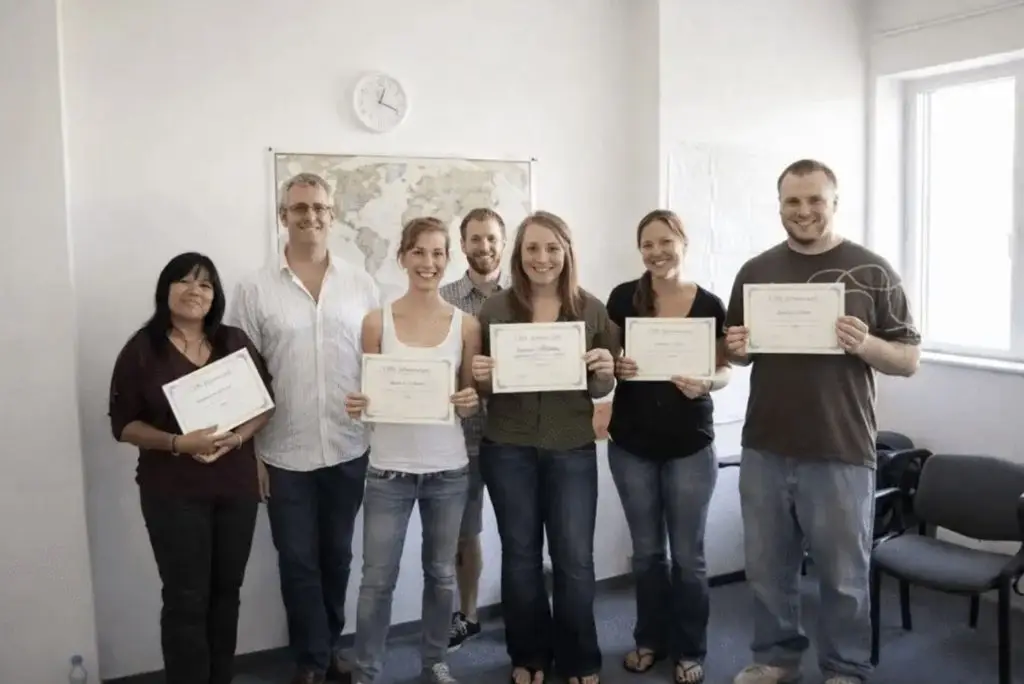
My TEFL cohort and our instructor on certificate day in Prague.
What Was My TEFL Course in Prague Like?
My in-person TEFL course in Prague was intense, practical, and the start of my whole life there. I lived with classmates from the course, and we spent our days learning to teach and our weekends exploring.
Our first trip out of the city was to Karlštejn Castle, about two weeks after I moved. A group of us from the course took the train out together. Those classmates became my first friends in a brand-new country.
Learning Czech Showed Me What My Students Would Feel
One of my favorite parts of the course was when our instructor taught us Czech phrases. I really struggled with “goodbye,” na shledanou. I said it wrong over and over.
That lesson stuck with me more than any lecture. It showed me exactly how my future students would feel: nervous, unsure, and trying hard to form new sounds. I still think about it when a student freezes up.
Teaching Real Students During the Course
Our TEFL course brought in real students for teaching practice. They were teens and young adults, which gave me my first taste of teaching older learners. Planning a lesson for a 19-year-old is very different from planning one for a 7-year-old.
English Grammar Surprised Me
I was surprised by how much I didn’t know about my own language. As a native speaker, you use all the English tenses without thinking. Explaining why we say “I have lived here” instead of “I lived here” is a whole different skill.
The final test was hard. I had to really study to pass it. If you take a TEFL course, plan on real homework, not just showing up.
From the Course to My Own Classroom
Afterward, I taught young learners at a language school in Prague. The course gave me the tools. The classroom taught me the rest. You can read more about life there in my guide to teaching English in Prague.

After my TEFL course, I taught young learners at a language school in Prague.
TEFL vs. TESOL vs. CELTA vs. TESL: What’s the Difference?
TEFL, TESOL, TESL, and CELTA are all English teaching qualifications, and most employers treat TEFL and TESOL as the same thing. So what does TEFL stand for next to the others? The main difference is where you plan to teach and who issues the certificate.
| Term | Stands for | Where you’d teach | Who offers it |
|---|---|---|---|
| TEFL | Teaching English as a Foreign Language | Non-English-speaking countries | Many private course providers |
| TESOL | Teaching English to Speakers of Other Languages | Anywhere, at home or abroad | Private providers and universities |
| TESL | Teaching English as a Second Language | English-speaking countries, like the U.S. | Mostly colleges and universities |
| CELTA | Certificate in Teaching English to Speakers of Other Languages | Anywhere, often adult learners | Cambridge English, through approved centers |
CELTA is the most standardized of the group. According to the Cambridge English CELTA syllabus, every CELTA course has at least 120 contact hours and six hours of assessed teaching practice. It usually costs more than a TEFL course.
For most first-time teachers heading to a language school, a 120-hour TEFL with teaching practice does the job.
Do You Need a TEFL Certificate to Teach Abroad?
You need a TEFL certificate for many teaching jobs abroad, but not all. It depends on the country, the type of school, and your background.
Some programs require it. For example, South Korea’s EPIK program (English Program in Korea, a government program that places teachers in public schools) asks for a “TEFL/TESOL/CELTA certificate (100+ hours, 20 in-class hours preferred),” according to the Korean Education Centre in Canada’s EPIK page. You can read more in my EPIK guide.
Private language schools in Europe and Asia often ask for one too. In other words, your license is the big qualification there. Always check the requirements page for the exact program or country you want. My guide to the NALCAP program in Spain walks through one example.
Do Licensed U.S. Teachers Need a TEFL Too?
Licensed U.S. teachers often don’t need a TEFL for international schools, but many language schools still ask for one. It depends on the type of school you’re applying to.
International schools (schools abroad that teach an American, British, or IB curriculum) usually care most about your teaching credential and classroom experience. Your license is the big qualification there.
Language schools, however, are different. They teach English as a subject, often to kids after school or to adults. Many of them want a TEFL even if you’ve taught for years, because teaching English to non-native speakers takes different skills than teaching your own students in English.
If you’re a current teacher, a TEFL can also be a low-cost way to test the idea. You could teach English abroad over a summer, or plan a longer stay during a leave of absence from your district.
Can You Get a TEFL Without a College Degree?
Yes, you can take a TEFL course without a college degree. TEFL stands for a training certificate, not a degree, and most course providers don’t require one. The catch is that many countries require a bachelor’s degree for the work visa, so the TEFL alone won’t always get you hired.
Some countries in Latin America and parts of Southeast Asia have more options for teachers without degrees. In much of Europe, Americans usually need a degree to qualify for the visa.
I break down where it’s possible in my guide to teaching abroad without a degree.

An online TEFL lets you study around your teaching schedule.
Online or In-Person TEFL: Which Should You Choose?
Online TEFL is cheaper and more flexible, while in-person TEFL gives you more hands-on teaching practice. Both can get you hired if the course is accredited and has enough hours. Online or in person, TEFL stands for the same certificate.
Choose in-person if: you want to arrive in a new country, make friends right away, and practice with real students before your first job. That’s what I did in Prague, and it made the move feel less lonely.
Choose online if you’re still working full time, want to study at your own pace, or aren’t ready to commit to a country yet. You can finish it on weekends and over school breaks.
Whichever you pick, look for three things: at least 120 hours, a teaching practice component, and outside accreditation (an independent group that checks the course quality). If you’re going the online route, I recommend Bridge TEFL (affiliate link). I explain why in my full Bridge TEFL review.
How Long Does It Take to Get a TEFL Certificate?
Most 120-hour TEFL courses take about four weeks in person or six to twelve weeks online. Online courses are usually self-paced, so you can go faster or slower around your schedule.
In-person courses run full-time, often weekdays from morning to late afternoon. Plan on homework and lesson prep most evenings, too.
If you’re timing a course around a job search, work backward from the hiring season in your target country. A good first step is getting your documents ready, like an international teaching CV.
FAQs: What Does TEFL Stand For?
Q: What does TEFL stand for?
A: TEFL stands for Teaching English as a Foreign Language. It means teaching English in a country where English isn’t the main language. It’s also the name of the certificate you earn after a TEFL course, which many language schools abroad ask for when hiring.
Q: What do the letters in TEFL stand for?
A: The four letters in TEFL stand for Teaching, English, Foreign, and Language. Put together, TEFL means Teaching English as a Foreign Language.
Q: Is TEFL the same as TESOL?
A: Mostly, yes. TESOL means Teaching English to Speakers of Other Languages, which covers the same skills. Most employers abroad treat a 120-hour TEFL and a 120-hour TESOL certificate as equal, so pick the course that fits your budget and schedule.
Q: Is a TEFL certificate worth it?
A: A TEFL certificate is worth it if you plan to teach at a language school or apply to a program that requires one. It also helps licensed teachers learn how to teach non-native speakers. If you’re only applying to international schools, your teaching license may matter more.
Q: How many hours of TEFL do I need?
A: Most schools and programs look for at least 100 to 120 hours. South Korea’s EPIK program requires 100+ hours, and Cambridge’s CELTA requires at least 120 contact hours. A 120-hour course with teaching practice covers most job requirements.
Q: Does a TEFL certificate expire?
A: No, a TEFL certificate doesn’t expire. Once you complete the course, you can use it for jobs years later.
Your Next Step After Learning What TEFL Means
Now you know what TEFL stands for: Teaching English as a Foreign Language. A 120-hour certificate with teaching practice opens many doors. You don’t need to have every answer today. You just need a clear next step.
If you’re starting to wonder whether teaching abroad could really work for you, my free checklist walks you through it in order, from the first questions to ask yourself to what to do this week.
Last updated: November 2026